As more drivers in Singapore switch to electric vehicles (EVs), the conversation around charging is changing too. It is no longer simply about whether charging points are available. Increasingly, the bigger question is whether residential estates can support growing demand conveniently and reliably over time.
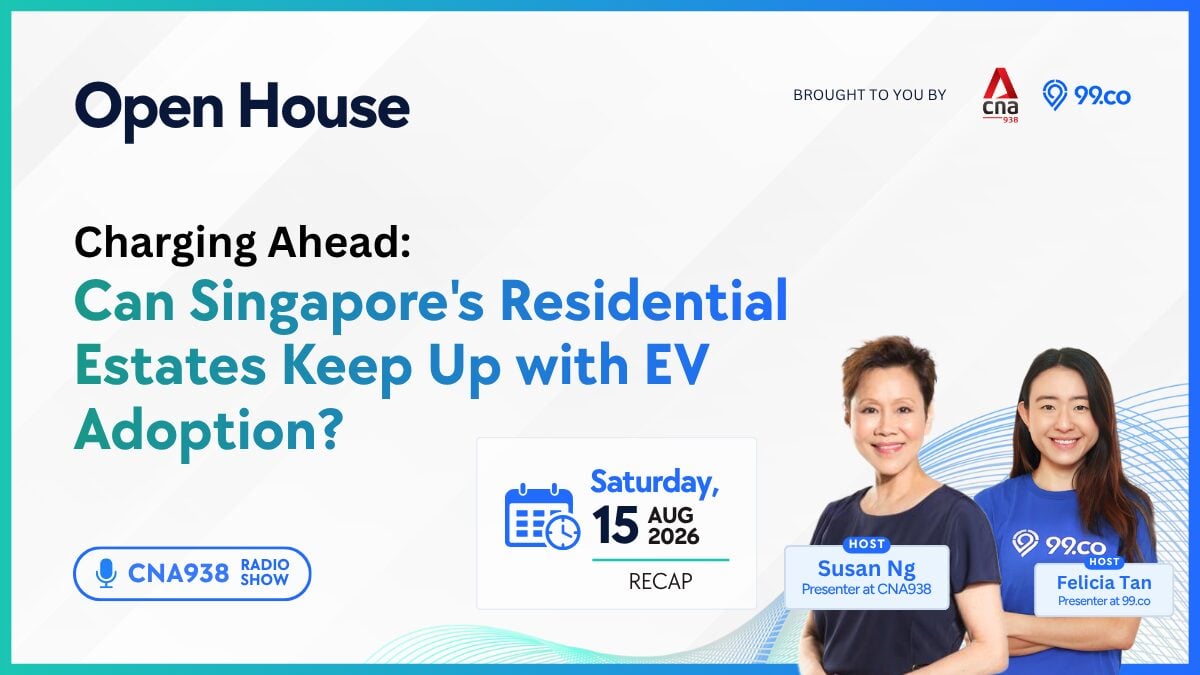
In a recent discussion, 99.co’s Felicia Tan and CNA938’s Susan Ng spoke with Dean Cher, Managing Director of SP Mobility, about how prepared Singapore’s residential estates are for wider EV adoption. Cher also explained why charger numbers alone do not tell the full story, especially as more EVs take to the roads.
Table of contents
- Singapore’s residential estates are broadly prepared, but not equally so
- Having more chargers is only part of the answer
- A good charging experience should almost be forgettable
- EV infrastructure also needs to be planned for tomorrow’s demand
- HDB estates and condos face different rollout challenges
- Older estates may have a tougher job retrofitting chargers
- For condos, cost and parking can become part of the debate
- Better charging management could reduce competition for lots
- Will EV charging become something homebuyers look for?
- The next step is not simply more chargers
Singapore’s residential estates are broadly prepared, but not equally so
According to Cher, Singapore’s residential estates are generally in a good position to support EV charging. However, the level of readiness differs depending on the type and age of the development.
For HDB estates, he pointed to the progress already made across Singapore. Cher said every HDB town was EV-ready, while more than 90% of HDB carparks had charging facilities by the end of 2025.
Meanwhile, charging infrastructure has also been growing in private homes. Cher cited figures from the EV Common Charger Grant, noting that 633 condominiums had installed close to 2,000 charging points as of around July last year. For landed homes, there are no similarly detailed figures, although private charging points also include chargers installed at landed properties.
Overall, he said Singapore had around 33,100 charging points as of the end of June, of which about 20,500 were private charging points. These private chargers cover more than homes alone and may also be found in places such as offices and other buildings with restricted access.
Still, having charging points in every residential segment does not mean every estate faces the same challenges. Older developments, in particular, may have limits on how much additional electrical load their existing infrastructure can support.
Having more chargers is only part of the answer
When EV demand grows, it may seem logical to simply install more charging points. However, Cher cautioned against using charger numbers alone to judge whether an estate is adequately served.
Instead, demand matters just as much.
One way of looking at this is to compare the number of EVs with the number of available chargers. For example, if a condominium has 100 EVs but only two charging points, each charger would effectively be serving 50 vehicles.
Adding more chargers would improve that ratio. However, the type of charger also matters. A condominium with a smaller number of faster DC chargers, for instance, may operate very differently from one that relies on slower AC charging points.
Location matters too. In a large condominium, putting every charger in one part of the estate may still make charging inconvenient for some residents. Spreading them across suitable locations could make them more useful.
As Cher put it, the better question is not simply how many chargers are available, but whether residents can “charge conveniently and reliably when they need to.”
A good charging experience should almost be forgettable
For drivers, a good EV charging experience should also be straightforward. Ideally, a resident should be able to arrive at a charger, find it available, begin charging without difficulty and return later to a sufficiently charged vehicle. In Cher’s words, charging should be “almost uneventful.”
However, making that possible requires more than installing the physical charger. Operators also need to consider reliability, clear information on charger availability, simple payment options and responsive customer support.
Fair-use measures can help as well. For instance, they can discourage drivers from occupying a charging lot long after their vehicle has finished charging. Ultimately, Cher said a good charging experience is one that fits naturally into a driver’s daily routine.
One example discussed was SP Mobility’s charging hub in Tengah. Located beside Plantation Plaza, it has eight DC fast-charging points of up to 100 kW, alongside six AC charging points. This gives residents different options depending on how much time they have. They could top up their vehicle more quickly while running errands or use an AC charger when parking for a longer period. The details of the Tengah hub, including the corrected 100 kW power rating, are also reflected in SP Group’s announcement.
EV infrastructure also needs to be planned for tomorrow’s demand
Another challenge is that EV demand does not remain still.
An estate may have enough chargers for its current residents, only to find that demand has grown considerably a few years later. Therefore, Cher said planning should consider both the electrical capacity available today and the number of EVs an estate could eventually need to support.
In other words, the infrastructure being installed today should also be able to support future expansion.
At the same time, not every charging session needs to take place at home. Drivers travel to workplaces, malls and other destinations throughout the day, many of which may also provide charging facilities. Cher therefore stressed that residential charging should be seen as one part of a wider charging network rather than the only solution. Public chargers located near where people live, work and spend their time can complement the chargers within residential estates.
HDB estates and condos face different rollout challenges
While the basic engineering considerations are similar across HDB estates, condominiums and even commercial developments, the way decisions are made can differ considerably.
For HDB carparks, planning and deployment can be coordinated on a wider scale through government agencies, EV-Electric Charging (EVe) and appointed charging operators. This allows decisions to be considered at a network or town level, which can help with coordination. EVe is an LTA subsidiary involved in deploying charging points at HDB carparks.
Condominiums, however, have a different decision-making process.
The MCST and residents may need to agree on the charging operator, where chargers should be installed, how the commercial arrangement will work and how future expansion should be handled. That process can take time. On the other hand, it gives a condominium the opportunity to choose an arrangement that suits the needs of its residents.
Older estates may have a tougher job retrofitting chargers
The difficulties can become more pronounced in older developments, which were not designed with EV charging in mind.
Electrical capacity is one of the main concerns. Older estates were originally built to power their common areas and other building systems. Adding EV charging introduces another source of demand, which means the incoming electrical supply and switchboards may need to be assessed before more chargers can be installed.
Physical space can create another challenge. Newer developments may have more flexibility to position charging equipment without taking up existing parking lots. In older estates, however, finding enough room can be harder, particularly for larger DC charging equipment. In some cases, installing the required equipment could even mean using space that would otherwise serve as a parking lot.
There may also be greater care required when carrying out works around older common property. As such, Cher stressed the importance of having the site properly assessed and the chargers installed professionally and safely.
For condos, cost and parking can become part of the debate
Even when a condominium is technically able to support EV chargers, residents may still need to work through several practical questions.
Who pays for the installation? Should residents who do not own EVs contribute towards the cost? Who maintains the chargers? How should the estate respond if demand rises? And how many parking spaces should be set aside for charging when most vehicles may still be internal combustion engine (ICE) cars?
These concerns can affect how quickly a condominium reaches a decision.
Cher suggested that one way to reduce uncertainty is to present residents with a transparent proposal from the start. This could explain the capital costs, operating model, electricity arrangements, maintenance responsibilities, allocation of charging lots and plans for future expansion.
He also noted that operator-funded arrangements are available in the market and may reduce some of the upfront costs. In addition, the EV Common Charger Grant can help with eligible installations at non-landed private residences. The scheme is available until the end of 2026 or until 3,500 chargers have received co-funding support, whichever comes first.
Better charging management could reduce competition for lots
As more residents switch to EVs, competition for charging lots could increase, particularly during peak periods. However, adding more chargers is not the only way estates can respond. Better management of existing charging points could also help ease demand.
Cher highlighted several measures already being used by charging operators, including live information on charger availability and notifications when a charging session has finished. Fair-use measures or idle fees can also encourage drivers to move their vehicles once they are done.
Etiquette matters too. An EV charging lot, Cher said, should be understood as “shared infrastructure”, rather than a permanent parking space reserved for one EV driver.
Pricing could also be used to spread charging demand across the day. Cher shared that SP has tried offering a 10% discount on AC charging between 10am and 4pm on weekdays that are not public holidays. This could encourage drivers who have more flexibility, such as those working from home, to charge during quieter periods instead of joining the evening rush.
Such managed charging could help estates make better use of their existing infrastructure while reducing some of the competition for charging lots.
Will EV charging become something homebuyers look for?
As EV ownership grows, charging infrastructure could also become another amenity that buyers and renters consider when choosing a home. However, Cher does not expect it to become the single factor that determines whether someone chooses a particular property. Buyers already weigh many considerations when making a property decision.
Still, for someone who owns an EV or expects to switch to one, knowing whether chargers are already available could be useful. Beyond that, Cher suggested looking at whether the development has planned for future growth in charging demand. In other words, a development may have chargers today, but the more important question could be whether it has been designed or planned with future expansion in mind.
Even then, home charging should not be viewed in isolation. Public chargers remain part of the overall picture, particularly as charging infrastructure expands around places where people work, shop and spend their time.
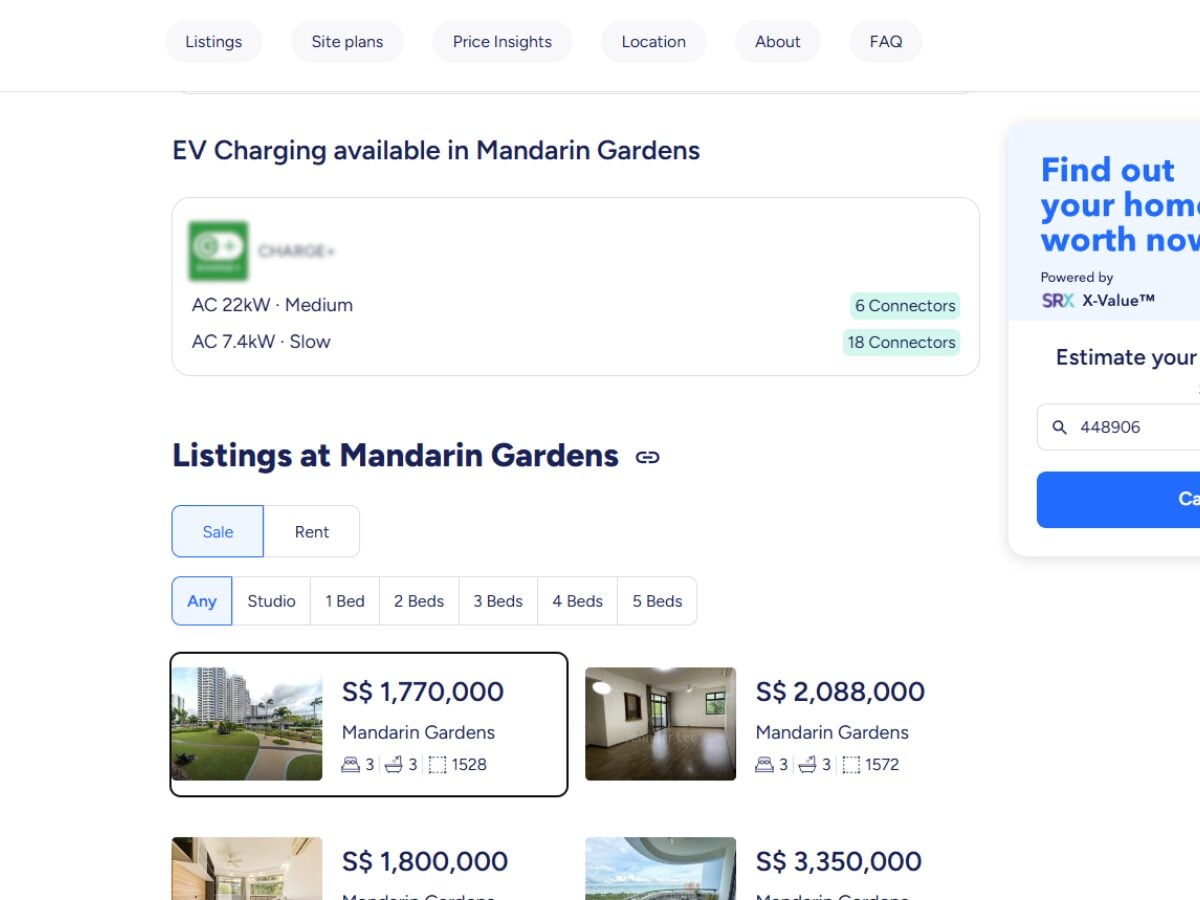
For home seekers who want to consider EV charging as part of their property search, 99.co now displays EV charging details on condo project and individual listing pages. These include the charging service provider, power output, connector type, charging speed and number of connectors available.
The EV charging section appears alongside other property details commonly used when comparing homes, including prices, available listings, floor plans, location and nearby amenities. This allows charging facilities to be considered as part of the wider property search, rather than having to be checked separately.
Read more: 99.co now includes EV charging information on condo pages
It may also be worth looking at even if an EV is not part of your plans today. Buying a home is often a longer-term decision, and access to charging could become more relevant if you switch to an EV later. For owners, it could also become another consideration for future buyers or tenants as EV adoption grows.
The feature is currently being rolled out progressively across condo pages and will eventually cover all condos. HDB pages are also set to receive EV charging details in a later phase. In addition, a future map feature is planned to show charging points around a property, giving home seekers a wider view of the charging options available nearby.
The next step is not simply more chargers
Singapore is working towards 60,000 EV charging points by 2030. However, Cher cautioned against becoming too focused on the headline number alone.
After all, drivers do not experience the charging network through a national total. They experience it through whether a charger is available when they arrive, whether it works reliably, whether it charges quickly enough and whether it is located somewhere convenient.
As Cher explained, placing many chargers in a location with little demand may help raise the overall charger count, but it does little for drivers. On the other hand, placing the right mix of AC and DC chargers in a well-used location could offer much greater practical value. Therefore, charging infrastructure will need to grow alongside actual and expected demand, while taking available electrical capacity into account.
For residential charging in particular, Cher believes the conversation will eventually need to move “from coverage to capacity” and “from installation to reliability.”
Just as importantly, the answer will not lie entirely within residential estates. Different drivers have different routines and charging needs, which means a mix of residential and public charging options will still be needed as EV adoption grows.
Ultimately, keeping pace with EV adoption will require more than installing enough chargers on paper. The bigger challenge will be making sure the wider charging network remains reliable, accessible and able to grow with the changing needs of drivers.

About Sophiyanah David

Sophi, a seasoned copywriter specialising in Singaporean real estate and property, is one of the minds behind 99.co's informative articles. Like her colleagues at 99.co, Sophi is dedicated to keeping you informed about the ever-changing world of real estate so you can find your forever home. When off the clock, you can find her giggling and kicking her feet as she reads her romance novels, watching anime - if FMBA is not your fave, she might fight you (but you'll probably win) and looking up latest skincare trends.

Looking to sell your property?
Whether your HDB apartment is reaching the end of its Minimum Occupation Period (MOP) or your condo has crossed its Seller Stamp Duty (SSD) window, it is always good to know how much you can potentially gain if you were to list and sell your property. Not only that, you’ll also need to know whether your gains would allow you to right-size to the dream home in the neighbourhood you and your family have been eyeing.
One easy way is to send us a request for a credible and trusted property consultant to reach out to you.
Alternatively, you can jump onto 99.co’s Property Value Tool to get an estimate for free.
If you’re looking for your dream home, be it as a first-time or seasoned homebuyer or seller – say, to upgrade or right-size – you will find it on Singapore’s fastest-growing property portal 99.co.
Meanwhile, if you have an interesting property-related story to share with us, drop us a message here — and we’ll review it and get back to you.
Join our social media communities!
Facebook | Instagram | TikTok | Telegram | YouTube | Twitter



Leave a comment