The Malaysian Ringgit’s weakness against the Singapore dollar has been dominating the news headlines recently, much to the cheer of many Singaporeans who love to cross the causeway over the weekends. Indeed,the exchange rate is no doubt something everyone watches intently – just head down to the nearest money changer to see what we mean. Exchange rate volatility affects every other region in the world, and for those who invest, it can either be a bane, or represent a window of opportunity. So,if you are new to speculating on foreign currencies, is this something too good to be missed?
Speculating vs Hedging
The main difference between speculating and investing is the amount of risk one takes. Typically, high-risk trades that are almost akin to gambling fall under the umbrella of speculation, whereas investments are made based on fundamentals and analysis. So if you are buying the Ringgit and think that it is likely to become stronger in the near term to sell and earn a profit, that is considered to be purely speculative..That’s a trade you made based on a hunch, not on proper analysis.
Hedging may appear similar, but its main premise is actually to reduce volatility and not to garner gains. In this aspect, the intention of initiating a trade is different. Hedging is often used by those who have a significant exposure to currency volatility, and wants to protect the value of their assets.
Here’s a simple example to illustrate this:
You’ve previously bought a studio apartment in the Iskandar region. It cost a total of RM 450,000 when you bought it in February this year when the exchange rate was 2.9 RM to 1 SGD. Now, the exchange rate is around 3.12 RM to 1 SGD. How much loss did you make, disregarding capital appreciation?
Price of studio apartment – RM 450,000
February 2016 in SGD terms – S$155,172
December 2016 in SGD terms – S$ 144,230
Exchange rate loss – S$10,942
SGD/MYR 1 year Chart
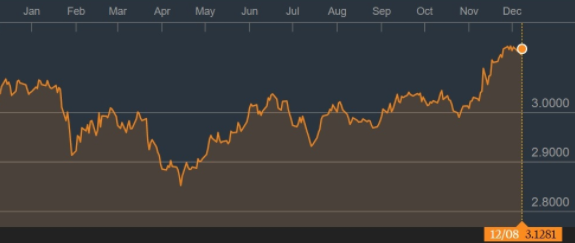
Close to S$11,000 in less than 12 months, quite a hefty sum isn’t it?
This is why it is important to hedge your currency risk if you have any assets denominated in foreign currencies or in other countries.
Let’s examine a scenario where you hedge your risks against a falling ringgit.
Say you are planning to sell your Malaysian property for RM 500,000 and at the time of purchase, the exchange rate was RM 2.9 to 1 SGD. You wish to guard against the ringgit from depreciating, so you set the notional amount of a non-deliverable forward to be RM500,000 where the broker gives you the contract rate of RM 2.9.
The possible outcome on the maturity date is:
- If the fixing rate is less favourable to you at RM 3.1, you would get the difference between the two rates from the contract, which is S$172,413-S$161,290 = S$11,123.
The cash settlement amount will compensate you for the difference in exchange rate when the buyer pays you RM500,000 pegged at RM 3.1 instead of your initial buying price rate of RM 2.9. Remember, if the exchange rate is favourable to you, you would need to pay back the difference to the broker as well.
However, hedging your risk perfectly is never easy and there can be plenty of downsides, including:
- difficulty in execution
- incurring additional costs
- becoming a form of speculation if the investor loses focus
But before you decide to not touch any foreign investments at all because of the complications of hedging currency risks, think about what could happen in the opposite scenario:
You decide to purchase an apartment in Malaysia now because the ringgit is currently at new lows. In a year’s time, the ringgit rose from the current 3.12 to 2.9, which means you would have made a loss of S$11,000.
So if you are interested to look into some currencies that have performed badly against the Singapore dollar this year, here are a few*:
SGD performance against Eurodollar(blue), Philippine Peso (Red), US dollar (Green) and British Pound (Orange)

*USD has only made recent gains against the SGD due to Trump’s win
Should You Invest in Overseas Properties?
If you are quite the risk-taker, you might be now thinking of investing in a property overseas where the currency has considerably weakened. But before you do so, there are a number of considerations to think about because buying a property is much more than just the (lower) purchase price.
-
What foreign currency is used for the property transaction?
When properties trade in the local currency, the most direct impact of exchange rates is the cost of the property in Singapore dollars. A strong Singapore dollar will buy more of the local currency/property, but when it is time to sell, a weak Singapore dollar is better because the price you get (in the local currency) will buy more dollars back home.
-
Are You Planning To Rent Out The Property?
First and foremost, the rental market in every country is different. As you may already know, Malaysia’s rental market is definitely not on par with that of Singapore since they have got much more land and supply available. Thus, if you are buying an overseas property for investment, you need to consider the average rental yield it can give you as part of the investment plan.
You are likely to receive your rental in local currency, which means you receive less when the currency is weaker. There are also operating costs to consider, such as utilities, taxes or maintenance fees that have to be paid in the local currency.
-
Do You Have Access To A Local Bank Account?
You can consider opening a dual-currency deposit account in a local bank so that you can store the local currency in your bank and use it for local expenses, then exchange it for Singapore dollars when the rates are in your favour.
It is important for investors to understand the risks involved in acquiring overseas assets. A poor exchange rate can result in unnecessary losses amounting to thousands of dollars so the use of hedging shouldn’t be ignored. On the other hand, buying properties overseas can give a savvy investor the upper hand, garnering profits if currency risk management is done correctly.
About Lynette Tan

Lynette has more than 7 years of experience in the financial sector and has been interviewed by various international media, including appearances on CNBC, BBC and Channel News Asia. With passion in financial literacy, she hopes to help others gain personal finance and investment knowledge through her writing.

Looking to sell your property?
Whether your HDB apartment is reaching the end of its Minimum Occupation Period (MOP) or your condo has crossed its Seller Stamp Duty (SSD) window, it is always good to know how much you can potentially gain if you were to list and sell your property. Not only that, you’ll also need to know whether your gains would allow you to right-size to the dream home in the neighbourhood you and your family have been eyeing.
One easy way is to send us a request for a credible and trusted property consultant to reach out to you.
Alternatively, you can jump onto 99.co’s Property Value Tool to get an estimate for free.
If you’re looking for your dream home, be it as a first-time or seasoned homebuyer or seller – say, to upgrade or right-size – you will find it on Singapore’s fastest-growing property portal 99.co.
Meanwhile, if you have an interesting property-related story to share with us, drop us a message here — and we’ll review it and get back to you.
Join our social media communities!
Facebook | Instagram | TikTok | Telegram | YouTube | Twitter





Leave a comment