
The best property analysis released these days is not about the red hot en bloc fever, or the optimistic projection of possible growth for the property market in 2018.
The only recent piece of analysis that leaves much food for thought is Ku Swee Yong’s three-part articles on Big Singapore Market Upgrade – Hype or Reality? where he questions Morgan Stanley’s remarks about “property prices on track to double by 2030”.
In particular, Mr Ku provides his personal data and analyses to highlight three important facts which I can’t agree with him more:
- Low population growth;
- Home ownership rate has peaked; and
- An aging population.
Slowdown in population growth
Still remember back in January 2013 when the government released the controversial Population White Paper (人口白皮书) and predicted Singapore’s population to reach 6 million by 2020 and 6.9 million by 2030?
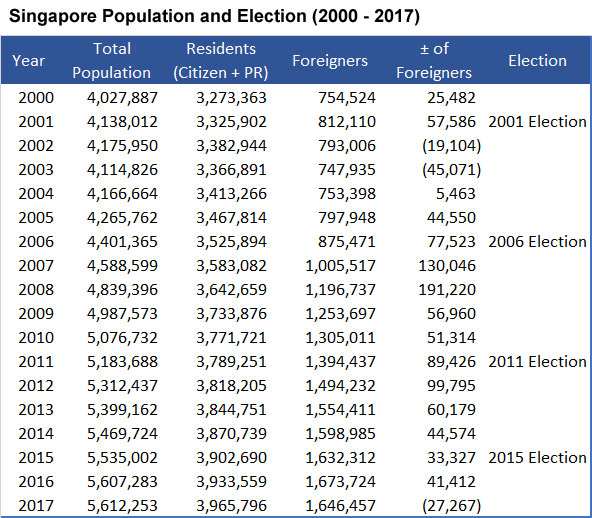
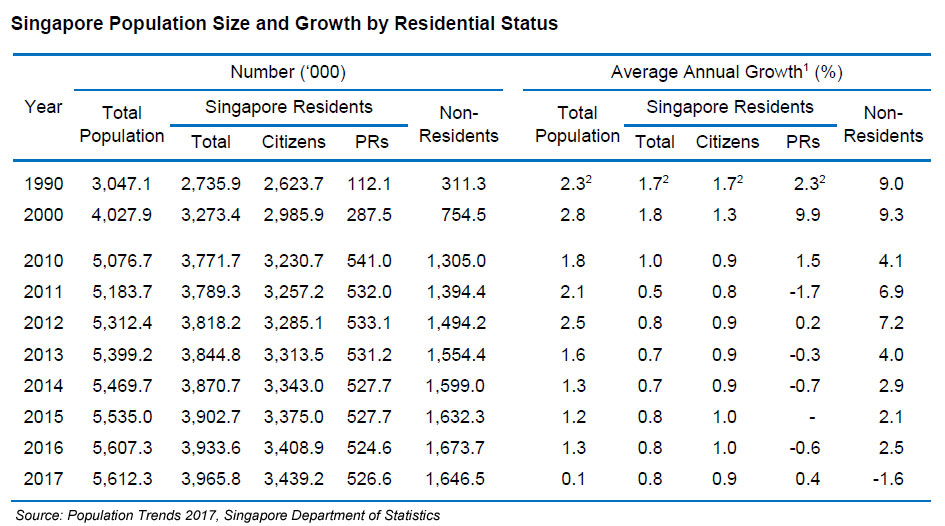
What is the latest update? Well, the Population Trends 2017 published this September by the Singapore Department of Statistics shows that our total population grew 0.1 percent to 5.61 million. It is the slowest annual growth rate since the year SARS hit our shores in 2003.
If we continue to inch 0.1 per cent every year, Singapore’s total population will only reach 5.69 million by 2030 – a far cry from the government’s ambitious target of 6.9 million.
If we need to have 6 million population by 2020, from now on we must have an annual growth rate of at least 2.2 percent, or add 126,000 more residents and foreigners every year to this Little Red Dot.
In 2016, there are 41,251 live-births but 20,017 total deaths for the whole year. The net increase in population is only 21,234.
With the next General Election coming in two to three years’ time, do you think there is any chance that the government will import 105,000 foreigners every year to fill up the gap?
Lesson learnt: Next time when the boss sets an ambitious target, instead of challenging him with a heated debate, just give him a neutral “okay let’s see” reply and let the unrealistic goal die a natural death.
Housing implications: The 2017 Financial Stability Review released by the Monetary Authority of Singapore on November 30 said it best:
“The development of en-bloc and GLS sites should more than double the number of units available for sale in the near term. In the medium term, the stock of private housing will increase. With slower population growth, there is considerable uncertainty as to whether existing vacancies and the new supply coming on-stream can be fully absorbed by the market. Should there be insufficient occupation demand for the completed housing units, a supply imbalance could result and place downward pressure on prices and rentals in the medium term.”
Where have all the foreigners gone?

If we look carefully at the numbers in population size, Singapore’s annual population growth hovers between 1.2 to 2.5 from 2010 to 2016. The exceptionally small increment of 0.1 percent last year is mainly due to the negative increase of -1.6 percent for non-residents.
A Straits Times article explains that this first drop in 14 years is mainly due to a decline in Work Permit holders.
But the reality is: foreigners on employment pass or work permit have to leave Singapore once they lose their jobs or when their contracts are not renewed, so they won’t affect our low unemployment rate and we can have headlines like “unemployment rate falls; incomes rise”.
The current size of permanent residents (PR) stands at 526,600 which hasn’t changed much for four years. This is also the government’s intention to keep the PR population stable after the number peaked at 541,000 in 2010.
Housing implications: Contrary to what Morgan Stanley said, housing demand is not determined by GDP, but unemployment rate. High unemployment rate affects both the sale and rental market. (Read my earlier post on “Why unemployment is the real killer in the property game”.)
It is now more difficult for foreigners to get approval for PR status. Foreigners are leaving the country but companies are not adding more expatriate positions.
The Additional Buyer Stamp Duty imposed on foreign buyers was raised to 15 per cent in January 2013. According to the Savills November Residential Sales Briefing citing URA’s 3rd quarter 2017 data, PRs and foreigners purchased 1,315 resale units, representing a 13 per cent quarter-on-quarter decline.
In the meantime, Singaporeans are the only hope for increase in housing demand. As Mr Ku has pointed out, Singapore home ownership has peaked at 90 per cent and policy makers are pushing for 100 per cent home ownership.
Locals don’t need to rent and we don’t have enough foreigners renting. No wonder vacancy rate of private residential properties still remains high at 8.4 per cent.
For property buyers and investors, there is some useful advice from MAS’s 2017 Financial Stability Review.
“Households should continue to stay financially prudent. While household debt growth remains in line with income growth over the past year, households should take into account their ability to service their debt in the longer term. Potential property investors should be aware that the subdued rental market and further interest rate hikes could weigh on borrowers’ debt servicing ability.”
Low birth rate and aging population

The 2016 total live-births is 41,251 and Singapore’s resident total fertility rate falls to an alarming rate of 1.2. It really takes a great programme like SG50 and a good dragon year once in 12 years like 2012 to push fertility rate to over 1.25.
The danger is that we have no mood to make babies when times are bad. During 2003 and 2005, Singapore only produced over 37,000 babies each year.
On the contrary, our citizen population continues to age rapidly, with the median age reaching 40.5 in 2017. Singapore citizens aged 65 and above has gone up to 14.4 percent in 2017, compared with 9.4 percent ten years ago, according to an article in Straits Times.
Housing implications: In April, the Ministry of Education announced the merging of 14 primary schools, six secondary schools and eight junior colleges (JCs) in 2019. Enrolment in JCs has declined since 2014 due to falling birth rates, with residents born between 1993 and 2002 falling 20 percent from about 49,000 to 39,000.
With declining birth rate, will “near to good schools” become a less important criterion one day for property buyers?
In Japan, where deaths have outpaced births for several years, toy manufacturers are designing toys for the elderly – a lucrative growing market compared with the shrinking demand from children.
The same applies to housing demand for our population.
According to Mr Ku, the number of “retiree households” has jumped from 54,000 in 2008 to 95,000 in 2016, an increase of 76 percent over 8 years. In ten years’ time, 558,000 Singaporean baby boomers will reach the retirement age of 60. Many are likely to cash out of their homes or prepare to downgrade after retirement.
Kampung Admiralty, with TOP just obtained in August, is the first retirement village in Singapore. The two blocks of HDB flats sold on 30-year lease were all snapped up during the July 2014 Build-to-Order exercise. The 104 studio apartments came with elderly-friendly fittings and a two-level medical centre providing treatment, medical and surgical services for residents.
Minister Khaw Boon Wan commented that “Kampung Admiralty is designed to fight against loneliness, ill-health and depression by encouraging inter-generational bonding, social interactions and active ageing”.
What about private housing? Are developers considering the aging population when building new projects? Have we thought about constructing granny houses and flats for the elderly like Australia? How about adding elderly-friendly home features and common facilities?
With the changing demographics in Singapore, the supply-demand dynamics of the property market will be very different from what we are seeing today. Are the consumers (tenants, homebuyers and property investors) and industry stakeholders (developers, builders, property agents, mortgage brokers, etc.) prepared for the big change?
If you enjoyed reading this article by Vina Ip, check out her previous article on The 7 deadly sins of Singapore property buyers and Chinese developers: who exactly are they?
This article was written by Vina Ip, expert property blogger, bestseller author and founder of Property Club Singapore on behalf of 99.co. As a property investor, Vina frequently researches and blogs about the Singapore property market, which you can read for free.
About 99.co

We are a property search engine with the overarching goal of building a more transparent and efficient property market. We are working towards that future by empowering people with the tools and information needed to find a place to live in the best way possible.

Looking to sell your property?
Whether your HDB apartment is reaching the end of its Minimum Occupation Period (MOP) or your condo has crossed its Seller Stamp Duty (SSD) window, it is always good to know how much you can potentially gain if you were to list and sell your property. Not only that, you’ll also need to know whether your gains would allow you to right-size to the dream home in the neighbourhood you and your family have been eyeing.
One easy way is to send us a request for a credible and trusted property consultant to reach out to you.
Alternatively, you can jump onto 99.co’s Property Value Tool to get an estimate for free.
If you’re looking for your dream home, be it as a first-time or seasoned homebuyer or seller – say, to upgrade or right-size – you will find it on Singapore’s fastest-growing property portal 99.co.
Meanwhile, if you have an interesting property-related story to share with us, drop us a message here — and we’ll review it and get back to you.
Join our social media communities!
Facebook | Instagram | TikTok | Telegram | YouTube | Twitter



Leave a comment