
At the time of writing this piece, the Singapore government has reinstated a stricter Seller’s Stamp Duty (SSD) framework, increasing the holding period from three to four years and raising the tax across all tiers by four percentage points.
Sellers now face a 16% tax if they sell within one year, and 4% even in the fourth year, a move clearly aimed at discouraging speculative flipping. Here are the new SSD rates as of 4th July, 2025:
| Holding Period | Old SSD (≤ 3 Jul 2025) | New SSD (≥ 4 Jul 2025) |
|---|---|---|
| ≤ 1 year | 12% | 16% |
| > 1 – 2 years | 8% | 12% |
| > 2 – 3 years | 4% | 8% |
| > 3 – 4 years | 0% | 4% |
| > 4 years | 0% | 0% |
While this move is seen as a cooling measure to curb market speculation, seeking to tame the rise in sub-sale transactions, the big picture deserves more clarity – this SSD revision should have minimal impact on the wider market.
Let’s understand why.
Table of Contents
- Sub-sales: Small slice of the pie, not the whole property market
- SSD changes are designed to remove excess speculation from the market. Here’s why new launch buyers will not be impacted
- What this means for buyers and developers
Sub-sales: Small slice of the pie, not the whole property market
Let’s start with what the SSD is really targeting. In the past few years, sub-sales—where someone resells a unit before the project is completed or shortly after TOP—have been on the rise.
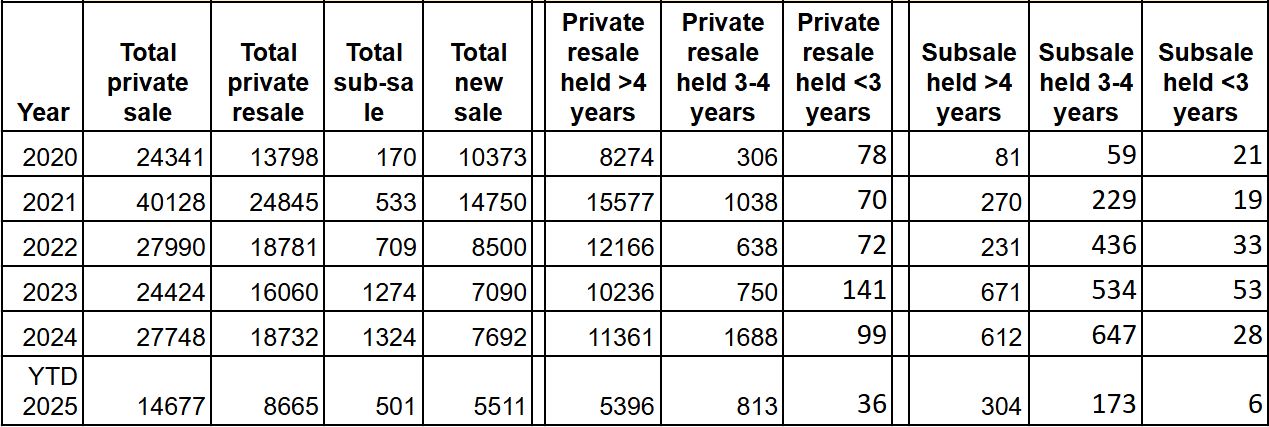
A closer look at sub-sale data from 2020 to YTD 2025 shows that the majority of sub-sale transactions already fall outside the new SSD penalty window. In 2024, for instance, 647 out of 1,324 sub-sales were made after holding the property for 3–4 years, while 612 sub-sales were held for more than four years. Only 28 sub-sales were held for less than three years, where SSD rates are now steepest.
This pattern holds true in YTD 2025 as well: just 6 of 501 sub-sales occurred within the first three years of holding. By contrast, 173 sub-sales (34.5%) fell into the 3–4 year window, and 304 (60.6%) were held longer than four years. This proves that most sellers are already aligned with the new policies and only a small section will be impacted by the rule change.
SSD changes are designed to remove excess speculation from the market. Here’s why new launch buyers will not be impacted
Some context helps here. The SSD isn’t new. In fact, what just happened is a reversion to rules that were already in place between 2011 and 2017. For a time, they were relaxed (down to three years of holding, and a 12% top tier) when the market needed more breathing room.
Here’s how the SSD rules have changed over the last decade:
| Period | Holding Period | Max SSD (≤ 1 yr) | Notes |
|---|---|---|---|
| 2011–2017 | 4 years | 16% | Introduced to clamp down on flipping |
| 2017–Jul 2025 | 3 years | 12% | Relaxed during cooling phase |
| From Jul 2025 | 4 years | 16% | Restored to pre-2017 framework |
There’s a common fear that raising SSD might deter buyers from entering new projects, especially those who see property as a wealth-building tool. But that worry is overstated because even under the more lenient SSD regime, sellers were holding longer due to rising financing and tax costs. Most investors were already pivoting to a “buy and rent” strategy, focusing on rental income rather than short-term resale profits.
What this means for buyers and sellers
For buyers: If you’re planning to hold for more than four years, as most buyers already do, the SSD hike is a non-issue. If anything, it protects your investment from speculative froth, helping stabilise prices and preserve value.
In fact, buying now might position you advantageously in the coming future. Buyers who have purchased new units before 4th July, 2025 will be in a unique position by 2028. Those who purchase later will still be within the SSD holding period in 2028, and there may be less competition at resale, thus allowing early buyers to enjoy a stronger exit window.
For sellers: If you bought pre-July 2025, you’re not subject to the new SSD structure. However, if you’re a seller who needs to right-size urgently, the added cost of the new stamp duty is now a real consideration. Many investors will likely hold and lease their units until the SSD expires.
We understand that any policy change can affect your buying or selling decisions—whether you’re a first-time homeowner, an upgrader, or an investor planning your next move. If you’re unsure how the new SSD rules might impact you, reach out to the team at 99.co for personalised insights and support. We’re here to help you navigate the property market with clarity and confidence.
About 99.co

We are a property search engine with the overarching goal of building a more transparent and efficient property market. We are working towards that future by empowering people with the tools and information needed to find a place to live in the best way possible.

Looking to sell your property?
Whether your HDB apartment is reaching the end of its Minimum Occupation Period (MOP) or your condo has crossed its Seller Stamp Duty (SSD) window, it is always good to know how much you can potentially gain if you were to list and sell your property. Not only that, you’ll also need to know whether your gains would allow you to right-size to the dream home in the neighbourhood you and your family have been eyeing.
One easy way is to send us a request for a credible and trusted property consultant to reach out to you.
Alternatively, you can jump onto 99.co’s Property Value Tool to get an estimate for free.
If you’re looking for your dream home, be it as a first-time or seasoned homebuyer or seller – say, to upgrade or right-size – you will find it on Singapore’s fastest-growing property portal 99.co.
Meanwhile, if you have an interesting property-related story to share with us, drop us a message here — and we’ll review it and get back to you.
Join our social media communities!
Facebook | Instagram | TikTok | Telegram | YouTube | Twitter





Leave a comment