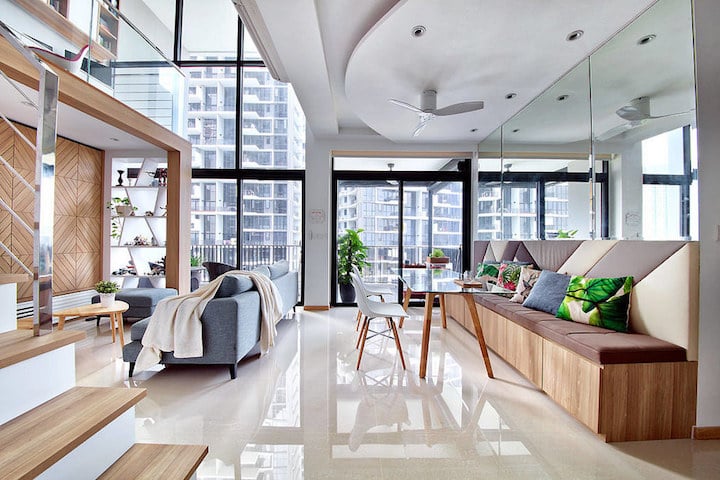
When The Straits Times ran the article Are you ‘paying for air’ when you buy a house? on 11 June 2018 (and more recently in February 2022, when a woman highlighted on TikTok that the actual weight of boneless chicken breast she bought from NTUC Fairprice is mislabeled), consumers are now increasingly more cautious when it comes to how much they’re getting as opposed to how much they’re paying.
In the ST article, it highlighted an unknowing buyer who was quoted a much higher price than the gross floor area for a new launch condo unit. The article’s intention was to inform buyers of strata void area, which is defined as the void space that is included in the total saleable floor area of the strata unit (e.g. condo unit), as our illustration of a 2-storey unit below shows:
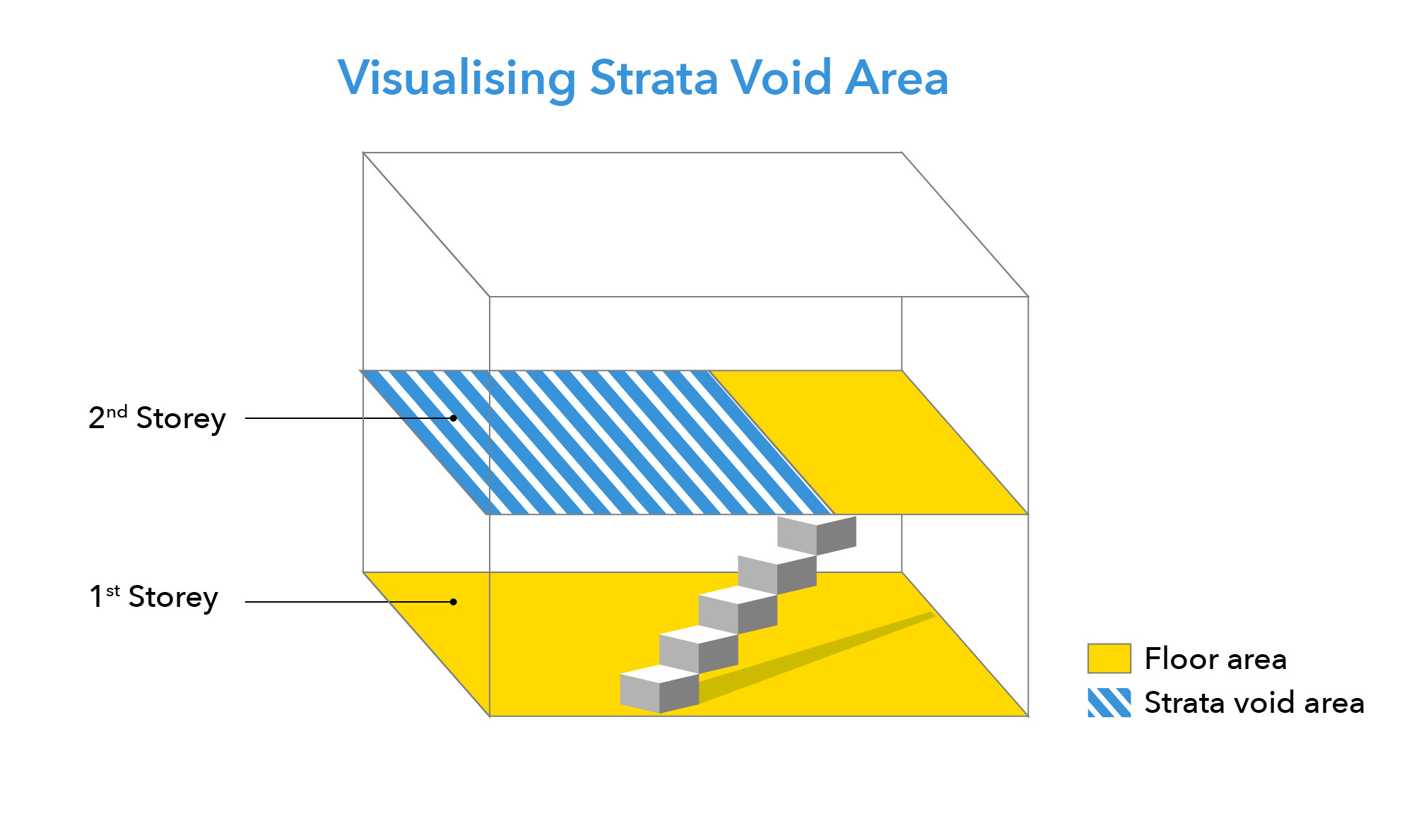
Per square foot, a strata void area may be 30 to 50% the price of actual floor area. This means that a condo unit with strata void area will list a lower psf price than a unit without. This may create some confusion in buyers who don’t immediately discern that a particular unit’s listed psf price is cheaper solely because of its strata void area, example below:
Assuming everything else is the same (e.g. rooms layout, facing, floor),
Unit A: 2,000 sq ft (inclusive of 500 sq ft strata void area) at S$1,300 psf priced at (2,000 x S$1,300) = S$2,600,000
Unit B: 1,500 sq ft (with regular ceiling height throughout) at S$1,600 psf priced at (1,500 x S$1,600) = S$2,400,000
To help buyers identify strata void areas without confusion, we’ve created a simple and straightforward guide. Bookmark this for the next time you’re viewing or buying a property — be it a strata condo or landed unit — so you’ll never be uncertain about “paying for air”.
Do: Pay attention to the floor plan
Since 2014, the Urban Redevelopment Authority (URA) has mandated that developers disclose the breakdown of the different areas in the unit, including any strata void areas, in sales documents such as the floor plan.
An example:
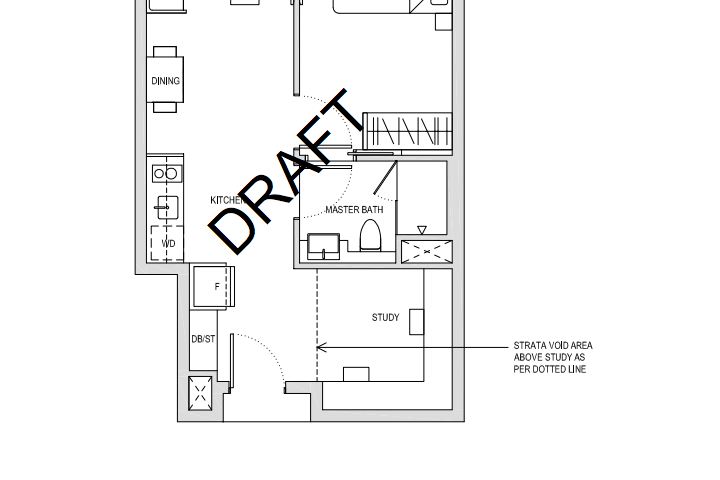
Another example:
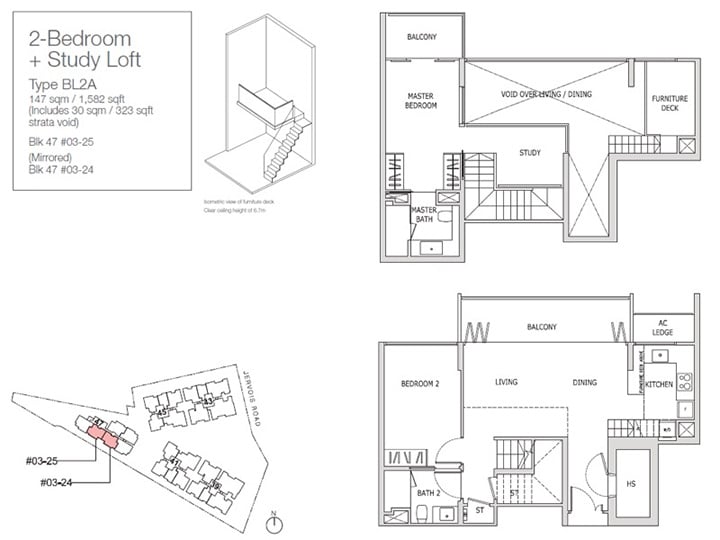
In other words, developers have an obligation to be transparent to the prospective buyer. Note that although the strata void areas are marked out in the examples above, the prospective buyer should go one step further and clarify the exact boundaries and area of the strata void area with the sales rep.
Do: Read sales documents carefully
Before the buyer pays the booking fee for his desired unit, the developer is required by law to provide him/her with the details of the unit and the housing project, such as the description and estimated areas of all spaces. This includes the void area, if any.
There’s more. The developer must obtain the buyer’s written confirmation of receiving such information. Buyers are understood to have read this information carefully before paying the booking fee.
So, regarding strata void areas, can buyers somehow argue that they were misled in any way? Let’s look back to 2014 when a couple took an executive condominium (EC) developer to court. The couple alleged that the penthouse they paid a S$56,050 option fee for was smaller than what they were led to believe.
In its defence, the developer argued that there had been no misrepresentation. This was because the Option to Purchase signed by the couple had clearly stated that the total saleable floor area took into account the air-conditioner ledge, roof terrace and the void area of the unit. The couple eventually dropped the suit.
This case shows that, at the very least, buyers are expected to recognise if any void area is specified on the developer’s sales documents (e.g. Option to Purchase, Sales & Purchase agreement) before they sign. The actual wording might be something like this:
(a) Floor area refers to the estimated area of the whole apartment, inclusive of the area of the air-conditioner ledge and voids (where applicable).
(b) Internal floor area refers to the estimated area of the apartment computed based on the centre line of the apartment wall.
Do: Obtain the necessary certificates (if the property is not a new launch)
If buying a resale condo unit, it might be harder for buyers to notice strata void areas given there might be a lack of documents from the outset. So, buyers should do the following instead before paying the option fee (information courtesy of the Singapore Land Authority, SLA):
Buyers who are buying an uncompleted property in the sub-sale market (i.e. not directly from the developer) should ask the seller for a copy of the Certificate of Strata Area from the seller before paying the option fee. The certificate would state the floor area of the property, including void areas, if any.
Before buying a completed strata unit for which a Subsidiary Strata Certificate of Title (SSCT) has been issued by SLA, buyers can buy a print-out of the SSCT to check the area of the strata unit and also check if the area of the strata unit includes any Void Areas. For SSCTs issued on or after 1 August 2012, Void Areas, if any, will be shown in the SSCT.
Before buying a completed strata unit, buyers can buy the Strata Certified Plan (CPST) for the strata unit from SLA’s Integrated Land Information Service (INLIS) to check if the unit interested in is affected by Void Areas.
If all this sounds complicated to you, that’s the cue for you to engage a CEA-registered Buyer’s Agent to help you with your home-buying journey.
How high must the ceiling be for it to be considered as strata void area?
This is where ambiguity can set in as the practices differ from one developer to another, and from one project to another. Generally, loft units with ceilings that aren’t high enough to allow standing on the loft deck do not count void areas. On the other hand, units with a “double volume” space as part of the strata area, such as a penthouse with a 4.7 metre floor-to-ceiling height, will have void areas factored into the total cost.
An important note for strata landed houses. If there’s an airwell or similar feature, buyers might end up paying for several levels of void areas between the ground floor and the roof. Investors of industrial and commercial spaces should also take note of strata void areas as tenants typically only take floor space into account when renting these spaces.
A good rule of thumb is, if you view a unit and you’re not comfortable when something is classified as a strata void area, just walk away.
–
Are you worried if you’re overpaying for void areas in your property? Let us know in the comments section below or on our Facebook post.
If you found this article helpful, 99.co recommends Private Enclosed Spaces (PES): Are you paying too much for them? and 9 must-ask questions at a new launch condo in Singapore.
Looking for a property? Find the home of your dreams today on Singapore’s fastest-growing property portal 99.co! If you would like to estimate the potential value of your property, check out 99.co’s Property Value Tool for free. Also, don’t forget to join our Facebook community page! Meanwhile, if you have an interesting property-related story to share with us, drop us a message here — and we’ll review it and get back to you.
About Kyle Leung

Content Marketing Manager @ 99.co

Looking to sell your property?
Whether your HDB apartment is reaching the end of its Minimum Occupation Period (MOP) or your condo has crossed its Seller Stamp Duty (SSD) window, it is always good to know how much you can potentially gain if you were to list and sell your property. Not only that, you’ll also need to know whether your gains would allow you to right-size to the dream home in the neighbourhood you and your family have been eyeing.
One easy way is to send us a request for a credible and trusted property consultant to reach out to you.
Alternatively, you can jump onto 99.co’s Property Value Tool to get an estimate for free.
If you’re looking for your dream home, be it as a first-time or seasoned homebuyer or seller – say, to upgrade or right-size – you will find it on Singapore’s fastest-growing property portal 99.co.
Meanwhile, if you have an interesting property-related story to share with us, drop us a message here — and we’ll review it and get back to you.
Join our social media communities!
Facebook | Instagram | TikTok | Telegram | YouTube | Twitter





Leave a comment