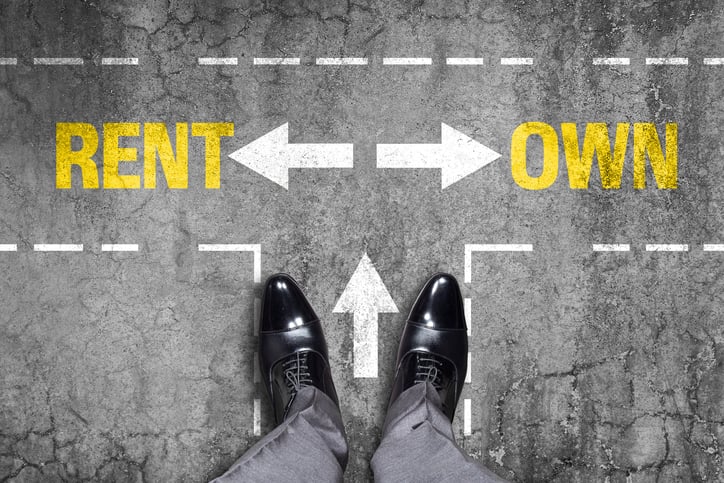
Many people assume that it is always better to be buying property rather than renting for the long term, since the monthly rent you pay maybe comparable to servicing a mortgage loan. This is even more apparent in a country like Singapore, where home-ownership is taken as an imperative.
But with the huge increase in property prices over the last decade, there has been much talk about how unaffordable properties are.. While the property cooling measures that are put in place since 2013 have helped to normalise property prices, rental price has fallen at a much faster rate as compared to property prices. According to data from the Urban Redevelopment Authority(URA), non-landed private property prices fell 2.6 percent in 2016, compared to a 4 percent decrease in rental rates last year.

From A Purely Financial Perspective
Let’s use two scenarios for the private property market in Singapore to examine if it is better to rent or to buy the same property. To provide an accurate comparison, we will use a 2-bedroom condominium unit from Cityscape @Farrer Park as an example:
Scenario 1: Renting property
The rental for a 1,076 sqft apartment in Cityscape is at an average of $3 per square foot per month. This would suggest that the starting rental would be around $3,228. Assuming that rental price rise at a 3 percent annual increase over the next 4 years, the total rent paid will be as illustrated below:
| Tenancy | Monthly Rent | Annual Rent Increase |
Total Annual Rent |
|
Year 1 |
$3,230 | – | $38,760 |
|
Year 2 |
$3,327 | 3 percent | $39,924 |
|
Year 3 |
$3,427 | 3 percent | $41,124 |
| Year 4 | $3,530 | 3 percent |
$42,360 |
| Total rent over 4 years |
$162,168 |
Over a period of four years, the tenant would have paid a total of $162,168. This figure does not include other additional costs of tenancy, such as utilities, stamp duties, reparations or the security deposit.
Scenario two: Buying property
Looking at a recent transaction in November 2016 for a unit of 1,076 sqft in the same condominium, the selling price was at $1.5 million. If we assume that the homebuyer gets a mortgage loan with a 30-year tenure, the mortgage amount is $1.2 million.
Initial costs would include a downpayment of $300,000, and a buyer’s stamp duty (BSD) of $39,600. This works out to a total of $339,600.
Of course, a huge amount of the money that goes to buying property is the cost of borrowing. While this can be hard to predict, we have done a simulation based on two different interest rate scenarios:
| 1.5 percent |
2 percent |
|
|
Monthly repayment |
$4,141 | $4,435 |
|
Annual mortgage payment |
$49,692 |
$53,220 |
| Annual maintenance costs | $3,600 |
$3,600 |
|
Property tax |
$1,000 | $1,000 |
|
Total costs per year |
$54,292 |
$57,820 |
| Total costs for 4 years | $217,168 |
$231,280 |
From the table, we can see that after four years, the total costs of ownership would work out to be at least $217,168 (excluding initial costs), which is $55,000 more than renting over the 4 years. Annually, you pay some $13,000 less if you rent the same condominium.
But consider the scenario where the person is looking to sell this condominium after 4 years. At this point, the remaining loan principal stands at around $1.07 million. Including all upfront costs and what he had paid for the 4 years of ownership, he would need to set a minimum selling price of $1.63 million to break even. This number is also excluding all miscellaneous payments of renovation costs, agent’s commissions and bank administrative fees.
This means that over 4 years, the owner would need to have his property appreciate by about 8.3 percent. What this implies is that if the annual growth in value of the home were to be less than two percent per year, or if interest rates were to rise to more than 1.5 percent, the homeowner might have been better off renting in the coming years.
But the financial aspect is only one factor out of many for most people deciding on whether to buy or rent. Short-term factors can include the possibility of moving to other countries due to work/family, financial commitment issues such as a retrenchment possibility, and even the near-term interest rate/rental/price outlook.
For those who are looking to buy a property and sell it within the next 5 to 10 years, the provided example may give you some food for thought, since you may find that the gain may not be as much as you wished for.
Check out other rental related articles here: Rent vs buy a property: here’s what Singaporean millennials prefer and Rent or buy home in Singapore?
Find the rental home of your dreams today at Singapore’s largest property portal 99.co!
About Lynette Tan

Lynette has more than 7 years of experience in the financial sector and has been interviewed by various international media, including appearances on CNBC, BBC and Channel News Asia. With passion in financial literacy, she hopes to help others gain personal finance and investment knowledge through her writing.

Looking to sell your property?
Whether your HDB apartment is reaching the end of its Minimum Occupation Period (MOP) or your condo has crossed its Seller Stamp Duty (SSD) window, it is always good to know how much you can potentially gain if you were to list and sell your property. Not only that, you’ll also need to know whether your gains would allow you to right-size to the dream home in the neighbourhood you and your family have been eyeing.
One easy way is to send us a request for a credible and trusted property consultant to reach out to you.
Alternatively, you can jump onto 99.co’s Property Value Tool to get an estimate for free.
If you’re looking for your dream home, be it as a first-time or seasoned homebuyer or seller – say, to upgrade or right-size – you will find it on Singapore’s fastest-growing property portal 99.co.
Meanwhile, if you have an interesting property-related story to share with us, drop us a message here — and we’ll review it and get back to you.
Join our social media communities!
Facebook | Instagram | TikTok | Telegram | YouTube | Twitter



Leave a comment