
When it comes to buying property in Singapore, one of the most common questions buyers face is: what’s better between high-floor vs low-floor unit? And in a market where every percentage point of appreciation or rental yield matters, understanding these nuances can have a significant impact on long-term returns.
It’s a classic property dilemma, and the answer isn’t as straightforward as you think. In this article, we take a floor-by-floor look at the resale market, examining both HDB flats and condominiums.
Drawing from exclusive conversations with 99.co agents Edwin Sia and Belinda Tan, along with data-backed insights, we unpack how floor level influences price, performance, and resale dynamics.
Table of Contents
- HDB resale trends: High vs. low floors
- Factors influencing HDB buyer choices
- Condo trends: Premium heights, patios, and pool access
- Niche demand for low-floor condos
- Investment insights: Rental yields and resale value
- Factors influencing buyer choices
- Final thoughts
- Meet our agents
HDB resale trends: High vs. low floors units
In the HDB resale market, high-floor units tend to hold a distinct edge in terms of appreciation and buyer demand.
This preference is rooted in better ventilation, reduced noise from street-level activities, and the prestige associated with height. HDB resale data supports this, with units from the 10th floor upward consistently fetching stronger prices.
High-floor units also benefit from improved privacy and ventilation. Elevated locations offer cooler breezes and reduced exposure to pests. However, they come with drawbacks such as higher prices, elevator dependency, and heat accumulation due to prolonged sun exposure.
In contrast, low-floor units are often more affordable and accessible. These are ideal for families with young children, elderly residents, or pet owners who appreciate quick access to outdoor areas. Yet, they are more exposed to noise from playgrounds and carparks, and may face privacy concerns due to proximity to common walkways or bin centres.
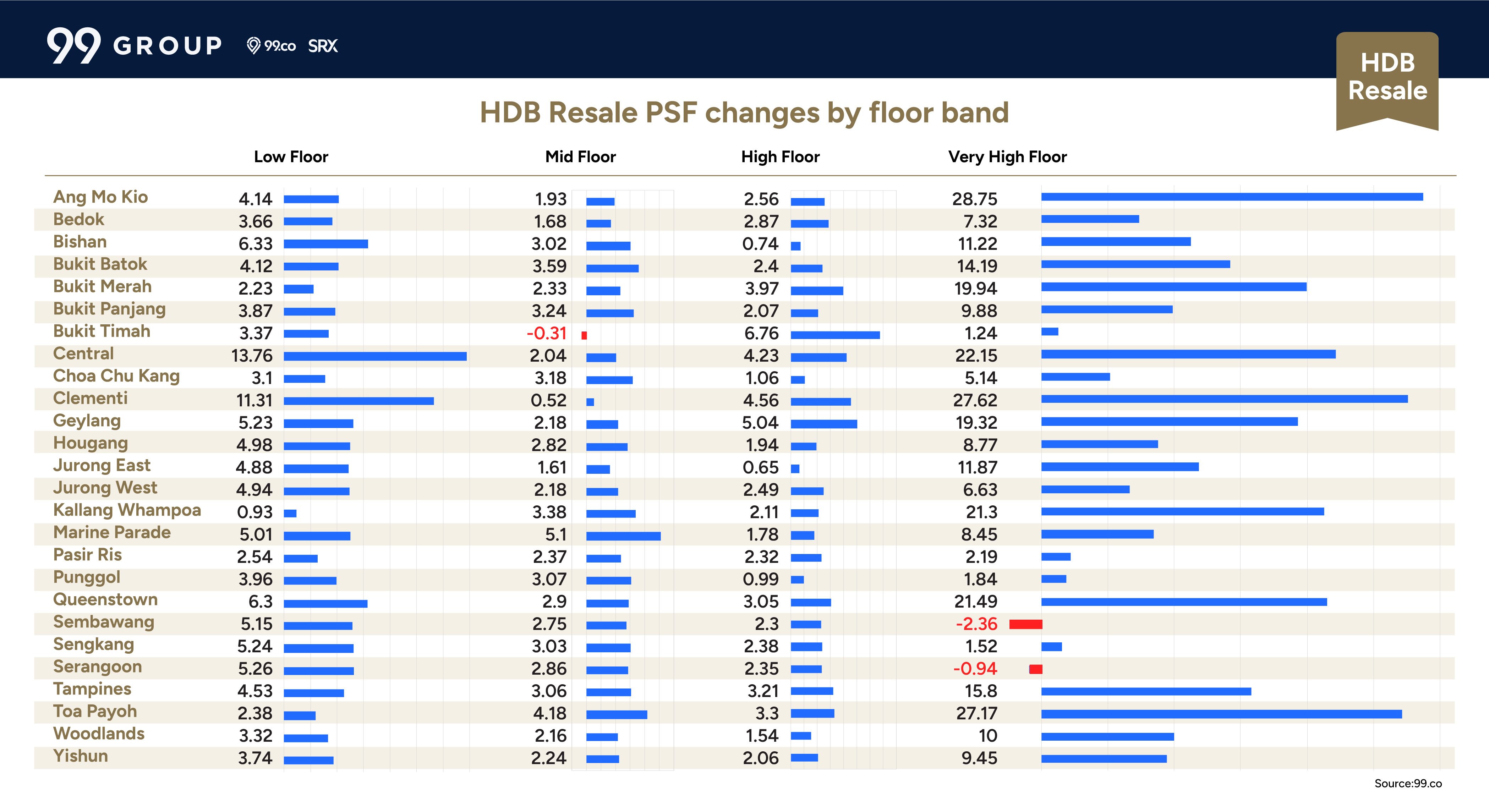
However, in mature estates where supply is tight, well-located and well-maintained low-floor units can also perform well. For instance, units close to MRT stations or with convenient access to amenities like wet markets and food centres can hold their own in terms of resale interest—even if they’re on lower floors (example Central and Bishan above).
Buyers are also influenced by practical considerations. Families with young children may prefer lower floors for easier stroller access and safety, while elderly buyers appreciate avoiding lifts altogether. Additionally, some buyers actively avoid heights due to vertigo or fear, making low-floor units more appealing.

 2
2
 2
2
 4
2
4
2
 3
2
3
2
 2
2
2
2
 3
2
3
2
 4
2
4
2
 6
4
6
4
 3
2
3
2
 3
2
3
2
 3
2
3
2
Condo trends: Premium heights, patios, and pool access
In private condos, the preference for high-floor units is even more pronounced. Premiums between lower and higher floors can range from 10–20%, especially in developments offering panoramic sea, city, or greenery views.
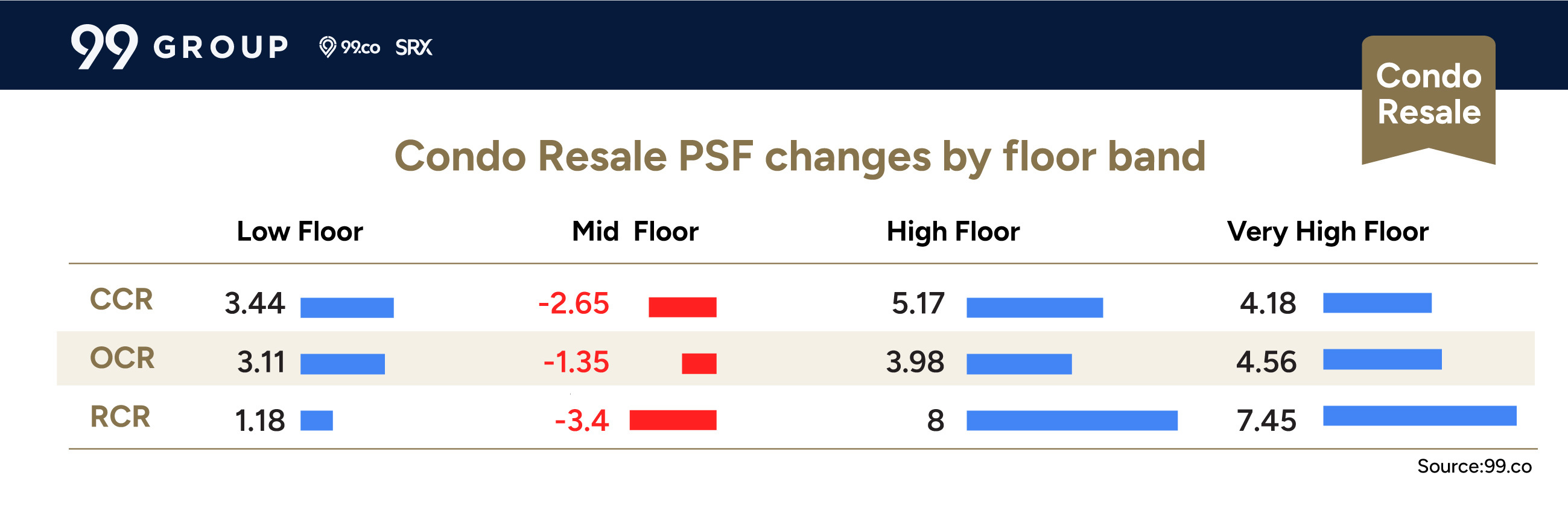 This is particularly evident in districts such as 9, 10, and 15, or projects located near the CBD and waterfront. New launch condos tend to sell from the top down, reflecting this premium for higher floors. These scenic units not only attract owner-occupiers but are also favoured by investors targeting expatriate tenants.
High-floor condo units offer premium views, better appreciation potential, and quieter environments due to reduced exposure to street-level activity. However, the trade-offs include higher costs, minor inconveniences like longer elevator wait times, and potential heat accumulation.
But in the high-floor vs low-floor units battle, the latter isn’t completely without charm, however. Ground-floor apartments with private enclosed spaces (PES) or direct pool access are increasingly popular in boutique developments, and offer a charm that HDBs usually lack. These are often marketed as “urban landed homes”—a hybrid between condo living and landed lifestyle.
During the height of the pandemic, Belinda recalls working with a family that toured several high-floor units before falling in love with a ground-floor apartment in Bukit Timah. “The moment they saw the patio, they could picture their kids playing outside while they worked from home,” she says. “They ended up paying above market just to secure it.”
Niche demand for low-floor condos
Not everyone is chasing the skyline, however. Here’s why some buyers are heading in the opposite direction.
Certain groups actively seek low-floor units. Families with young children often avoid balconies for safety reasons and prefer direct pool access. Seniors or those with mobility issues value being closer to ground level, and pet owners appreciate quick access to outdoor spaces for walks.
Our agents have also seen instances where some investors deliberately target lower floors because of their lower entry price. The cost differential across floors allows for a better rental yield and potentially greater capital upside if the unit is located in a high-demand neighbourhood.
For new launches, developers often price in a floor premium ranging from $5,000 to $10,000 per level. This premium can climb even further for units on super high floors, particularly those offering unblocked or scenic views. This explains why lower-floor units for some new launches are among the first to be snapped up by seasoned investors.
Integrated developments—where residential units sit atop malls or MRT stations—also skew this logic. In these settings, convenience often trumps height, and even mid or low-floor units with direct access to amenities enjoy high demand.
In gentrifying neighbourhoods such as Tiong Bahru or Joo Chiat, well-renovated low-floor walk-up apartments have seen outsized appreciation due to their unique character and central location. Resale condos often sell from the bottom up, indicating a different demand dynamic compared to new launches.
 3
2
3
2
 1
1
1
1
 1
1
1
1
 2
2
2
2
 4
5
4
5
 2
2
2
2
 2
2
2
2
 3
2
3
2
 3
3
3
3
 2
2
2
2
Investment insights: Rental yields and resale value
From an ROI perspective, low-floor units can present value-for-money opportunities. Developers typically use tiered pricing strategies, with every floor commanding a $1,000 to $3,000 increase depending on the view.
This means that low-floor units often provide a better dollar-per-square-foot value. For instance, new condos typically see a price increase per floor (e.g., $10,000 per floor for a 3-bedroom unit).
While appreciation may be slower compared to higher-floor units, savvy investors can still maximise returns by choosing well-located low-floor units that appeal to niche tenants. For instance, units facing internal gardens or those with corner layouts tend to outperform their generic peers.
In terms of rental yield, the differences are often marginal—about 0.1% to 0.3% between floors in many developments. However, ground-floor PES units, when marketed effectively, can command premium rents.
Factors influencing buyer choices
| Buyer Segment | Preferred Floor Type | Reason |
|---|---|---|
| Families with kids | Low-floor | Safety, patio access |
| Seniors | Low to mid-floor | Lift independence, convenience |
| Investors | High-floor or Low-floor | Prestige or better ROI |
| Pet owners | Ground-floor | Easy outdoor access |
| Budget buyers | Low-floor | Affordable entry point |
There’s a widespread perception that low-floor units are less desirable, primarily due to concerns over privacy, pests, and noise. Flats near playgrounds or carparks may be exposed to more foot traffic and sound pollution. In older developments, pest issues such as cockroaches and ants are more prevalent at lower levels. This is further compounded by the proximity to the rubbish chute and collection centre, which can cause smells and other issues.
Yet, accessibility is a game-changer. For example, in walk-up flats where there’s no lift access, lower-floor units become far more practical. Additionally, flats with favourable internal-facing orientations—like those overlooking gardens instead of roads—can mitigate the common downsides of low-floor living.
HDB Transactions by Floor Bands
| Floor Level | YoY Change 2023 | YoY Change 2024 |
|---|---|---|
| Very Low | -5.42% | 13.89% |
| Low | -4.74% | 10.87% |
| Mid | -2.02% | 5.53% |
| High | -1.93% | 2.84% |
| Very High | -7.67% | 7.79% |
| Floor Level | YoY Change 2023 | YoY Change 2024 |
|---|---|---|
| Very Low | -12.11% | 10.28% |
| Low | -11.27% | 16.96% |
| Mid | -0.93% | 13.85% |
| High | -12.48% | 21.63% |
| Very High | -6.97% | 21.67% |
From an investment perspective, high-floor flats may offer better long-term appreciation. But if priced right, low-floor flats in good locations can deliver solid rental yields and hold value, especially in family-centric neighbourhoods.
We see this in the data above. Coming out of COVID both HDB and condo transactions saw a drop in 2023, but by 2024 both sectors had recovered well. What is important to notice that among HDB transactions, the highest delta was seen for low and very low floors (13.9% and 10.8% respectively), while even lower-level condos fared pretty well.
As both Edwin and Belinda note, while HDB appreciation trends favour higher floors, the valuation logic means many low-floor buyers see strong relative ROI simply because of their lower entry price.
High-floor vs low-floor units: Final thoughts

Whether you’re chasing city views or seeking serene, grounded living, the “best” floor level isn’t about a number—it’s about fit. Knowing how floor level influences pricing, practicality, and future value helps you make more confident property decisions.
In Singapore’s fast-moving market, it’s not just about where you live; but how smartly you choose to live there. In the end, there is no one-size-fits-all answer in the high-floor vs low-floor units debate. It boils down to your preferences, budget, the area you’re living in and what is more important to you as a homeowner. It’s important to understand trends but more than that, it is necessary to evaluate each home on its own merit and choose accordingly.
Meet Our Agents


About 99.co

We are a property search engine with the overarching goal of building a more transparent and efficient property market. We are working towards that future by empowering people with the tools and information needed to find a place to live in the best way possible.

Looking to sell your property?
Whether your HDB apartment is reaching the end of its Minimum Occupation Period (MOP) or your condo has crossed its Seller Stamp Duty (SSD) window, it is always good to know how much you can potentially gain if you were to list and sell your property. Not only that, you’ll also need to know whether your gains would allow you to right-size to the dream home in the neighbourhood you and your family have been eyeing.
One easy way is to send us a request for a credible and trusted property consultant to reach out to you.
Alternatively, you can jump onto 99.co’s Property Value Tool to get an estimate for free.
If you’re looking for your dream home, be it as a first-time or seasoned homebuyer or seller – say, to upgrade or right-size – you will find it on Singapore’s fastest-growing property portal 99.co.
Meanwhile, if you have an interesting property-related story to share with us, drop us a message here — and we’ll review it and get back to you.
Join our social media communities!
Facebook | Instagram | TikTok | Telegram | YouTube | Twitter



Leave a comment