Update as of 20 October 2021: Best Electricity has announced that it is exiting the consumer open electricity market as well.
Update as of 16 October 2021: Two OEM electricity providers – iSwitch and Ohm Energy – have recently announced that they will be exiting the electricity market in Singapore. Some reasons include the volatile electricity market that made pricing plans lower than the regulated tariff unsustainable and rising fuel costs.
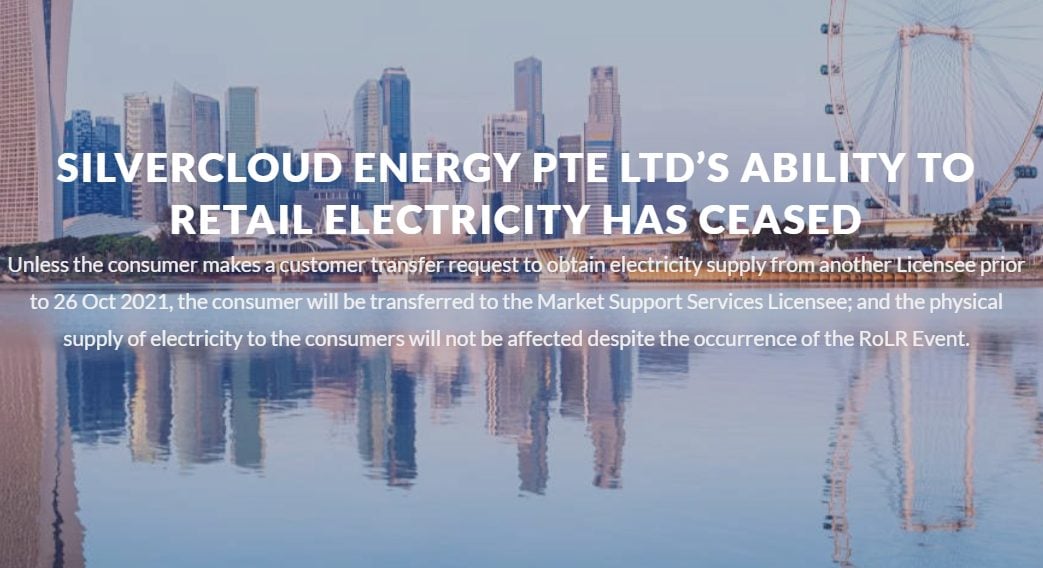
There’s also a Reuters report stating that SilverCloud Energy, which supplies power to commercial, industrial and residential buildings have similarly announced its exit from the market.
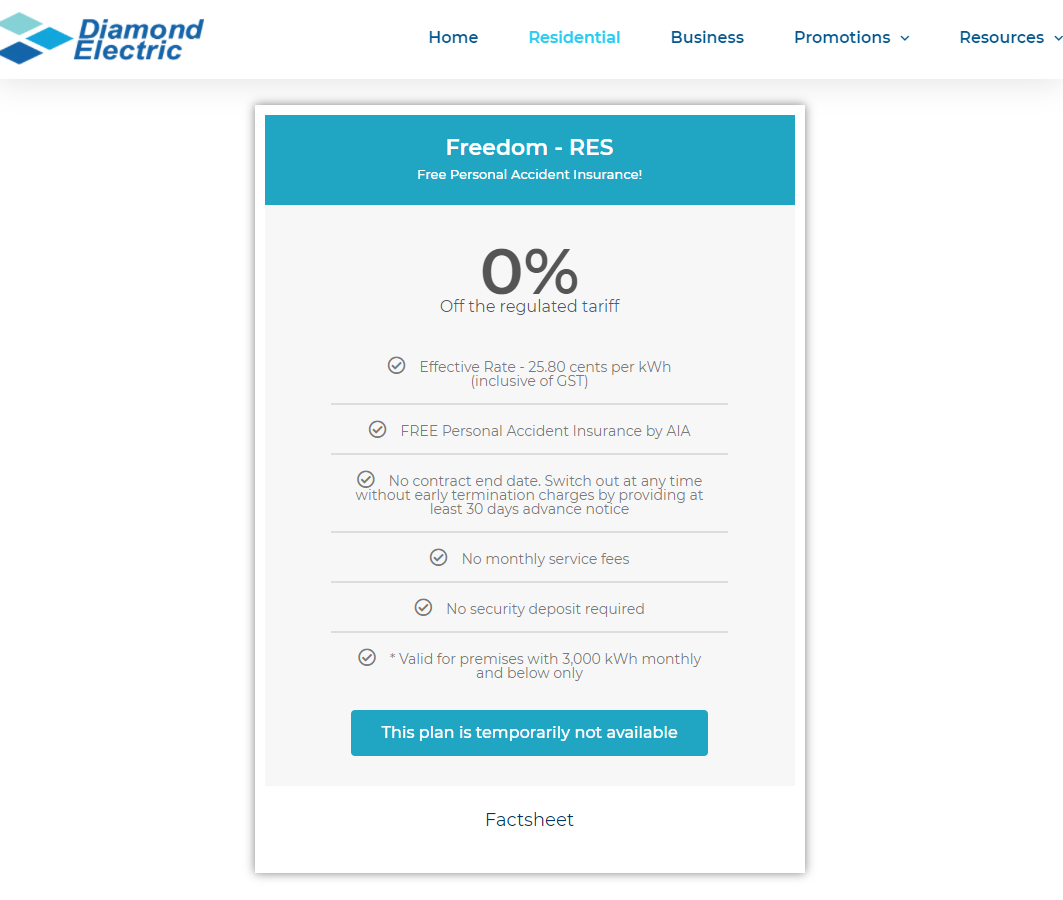
Also, it is understood from this report that Diamond Electric currently only features a 0% discount off the prevailing regulated tariff (with a note saying that ‘this plan is temporarily not available’) while Best Electricity’s website is now defunct (as of June 2022).
Original article (with updates as of 14 June 2022):
When the Open Electricity Market (OEM) officially rolled out across the country between 2018 to 2019, Singaporeans were no longer restricted to purchasing their power solely from SP Group. What’s the rationale behind the OEM? How do you switch to another electricity provider? What type of plans are available?
In this article, we cover all those questions and more, so you can decide whether to make the switch.
What is the Open Electricity Market (OEM)?
The Open Electricity Market is an initiative that was launched in 2018 by the Energy Market Authority (EMA). The OEM allows you to choose between electricity retailers in the same way you can choose between, say, telcos. But it’s not necessary to switch if you don’t want to; you can keep buying from Singapore Power Group (SP Group).
Also, note that SP still maintains and operates the power grid, so reliability is unaffected when you switch to a retailer.
How does the Open Electricity Market work?
Under the OEM, consumers can now shop for electricity plans from a wide range of providers. The goal of this initiative is to liberalise the local retail power market, and allow consumers to benefit from “competitive pricing” and “innovative offers”.
Prior to the OEM, only businesses with monthly electricity consumption of 2,000-kilowatt-hours (kWh) and above could decide which provider to purchase their electricity from.
When will I get to switch my electricity provider?
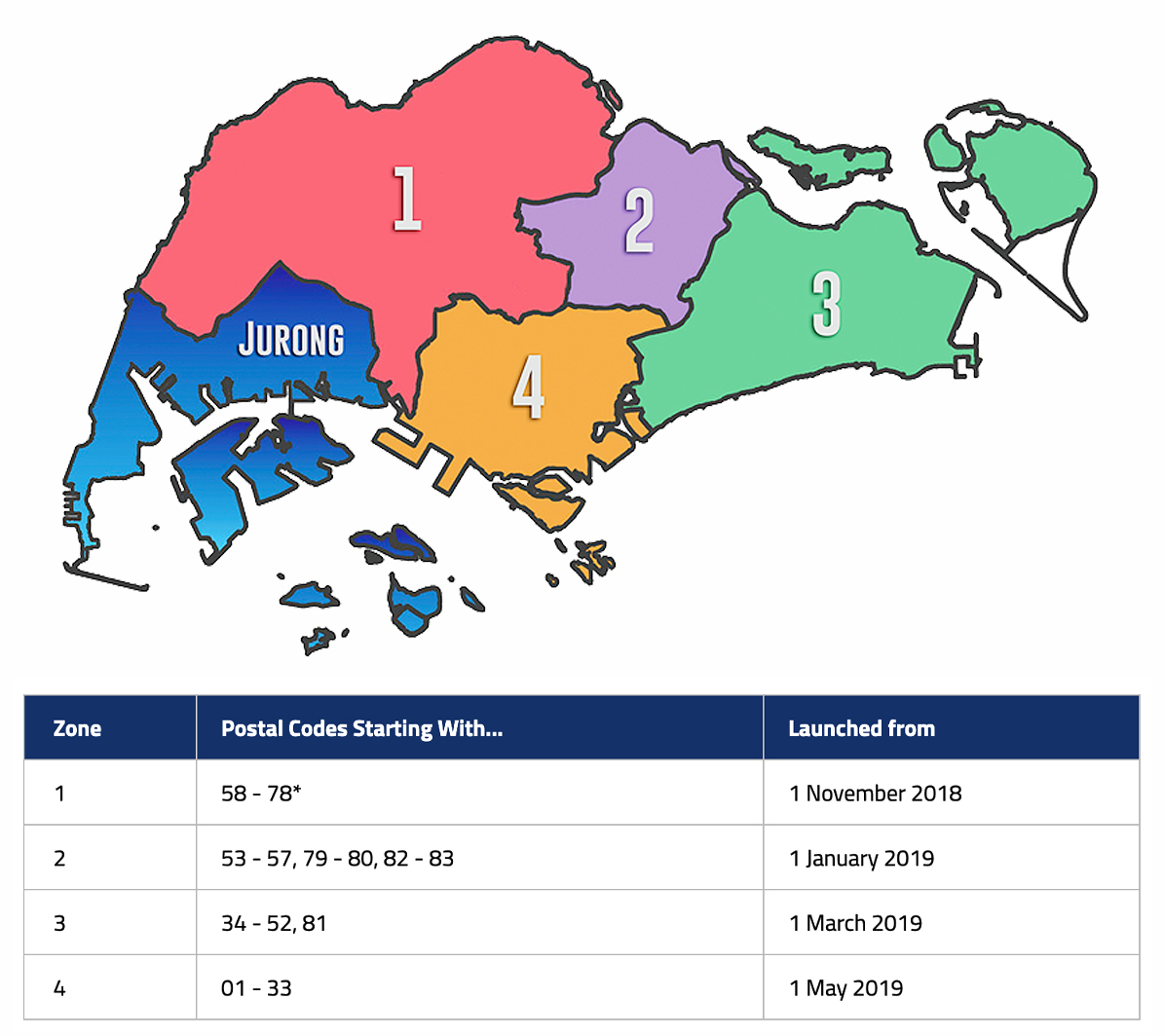
After a successful soft launch of 108,000 homes and 9,500 businesses in the district of Jurong, households and businesses with postal codes 58 to 78 — about 350,000 accounts — can choose to switch to an electricity retailer of their choice from 1 November 2018 onwards.
Subsequently, the OEM will be progressively rolled out across the country. The phased roll-out will be done in four batches, and the second batch will get to choose their energy retailer from 1 January 2019 onwards.
The diagram below illustrates the rest of the roll-out; by 1st May 2019, all consumers in Singapore will be able to switch their energy providers.
What’s the point of switching providers?
In a broad sense, competition helps to keep prices low, as each retailer is fighting to get customers. It also encourages innovation and productivity among the competing companies, so we customers can get a better deal.
Most plans offered by electricity retailers are 12 to 24-month contracts, although some retailers differ. For example, Tuas Power has a plan that’s only 6 months so you can test it out.
If you’re interested, check what you have to pay after 6 months and see if it’s lower than your usual bill.
About 49% of household accounts and 47% of business accounts have switched to buying electricity from a retailer of their choice as of 30 April 2021.
What are the different electricity plans available?
The Energy Market Authority (EMA) stipulates that electricity providers offer two standard price plans. That said, there are three types of price plans available, which you can pick to suit your needs:
- Fixed Price Plan
- Discount Off Tariff (DoT) Plans
- On and Off-Peak Plans
1. Fixed Price Plans
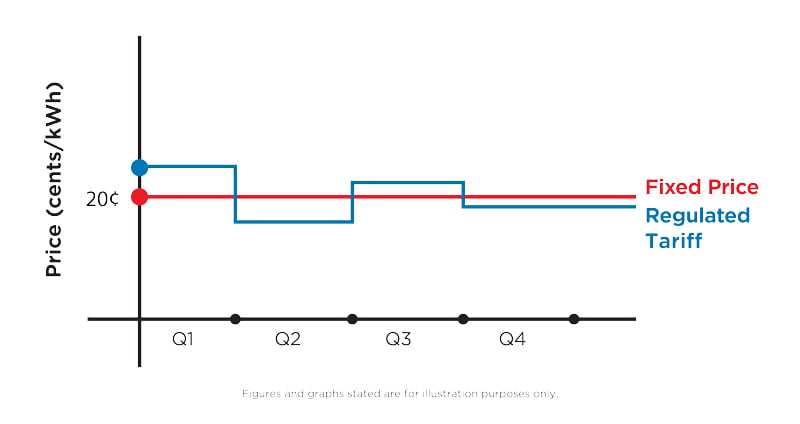
Fixed price plans are pretty self-explanatory; you pay a fixed rate for the electricity you use (e.g. 20 cents/kWh) throughout your entire contract.
This amount doesn’t change, regardless of rising or falling energy costs. So if the price of energy happens to fall while you’re on this plan, you’re paying more. If energy costs rise while you’re on this plan, you’re saving money.
Fixed price plans are likely to be more suited to business owners who want to keep their energy costs fixed, making it easy for them to plan and estimate their expenditure.
This plan is also worth a second look for residential landlords who rent out their entire apartments since this makes clear how much electricity charges to factor into the rent.
2. Discount Off Tariff (DOT) Plans
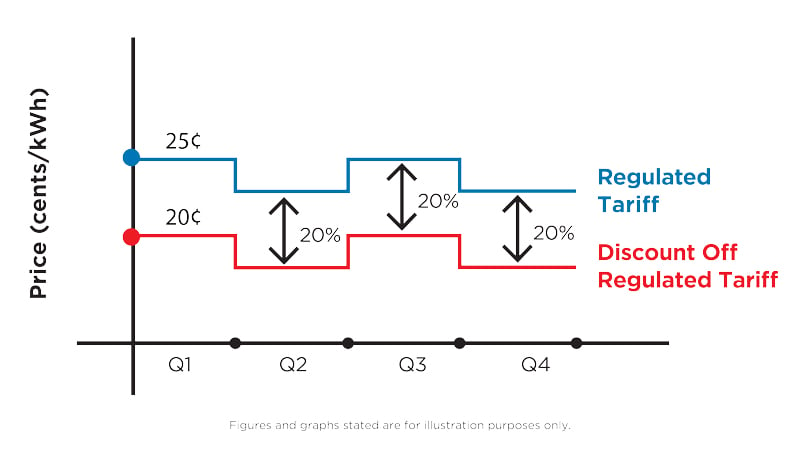
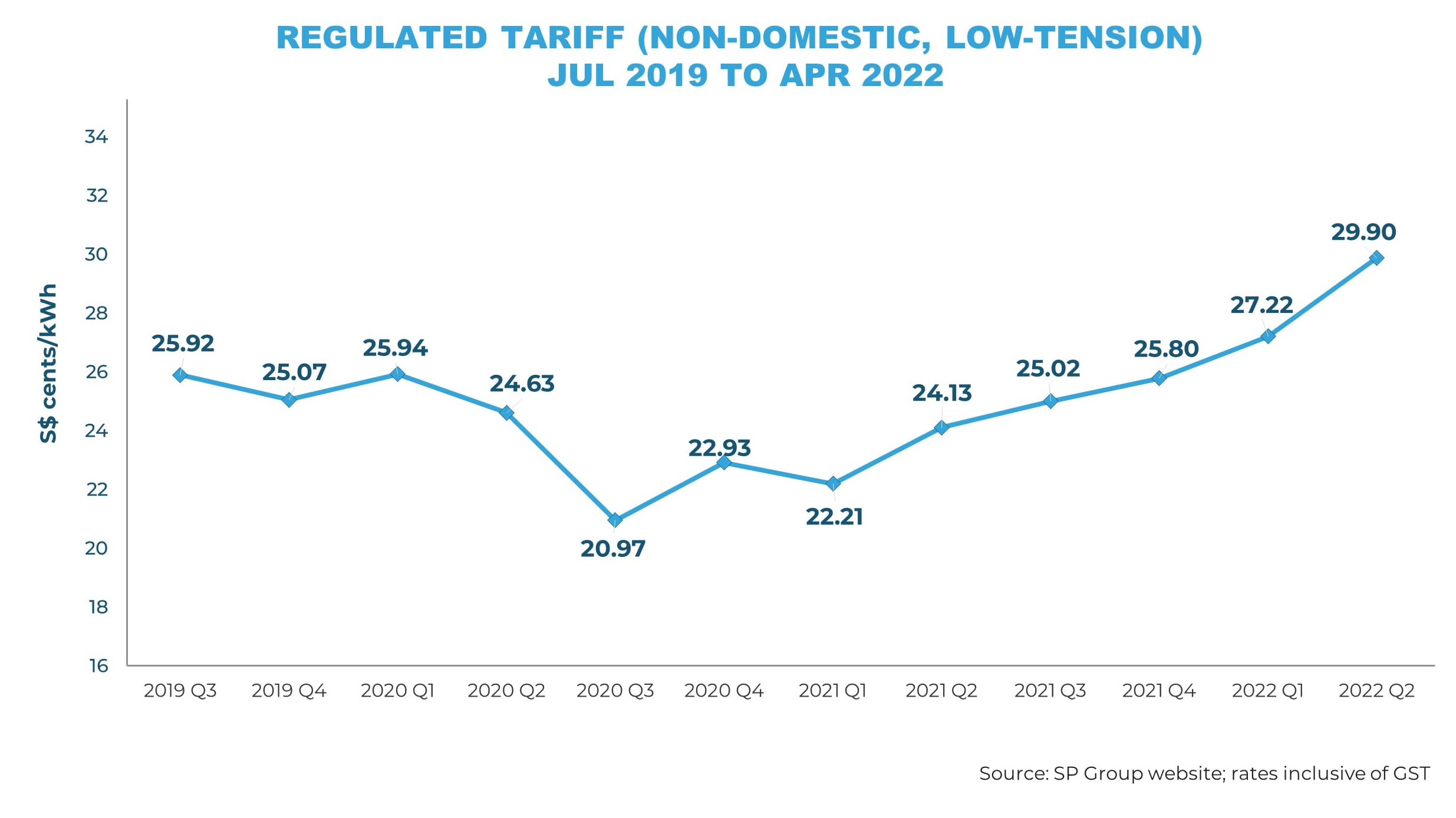
The Discount Off Tariff (DOT) plans, on the other hand, give you a discount off the prevailing regulated tariff price. The tariff price is revised every quarter, and it’s currently 27.94 cents / kWh until 30 June 2022.
While taking this plan does mean the price fluctuates, it also means you’ll always pay less than you would if you bought from SP.
This is the OEM plan most homeowners will settle for.
Increase in demand for natural gas
Global energy prices spiked in 2021 and 2022, due to the global energy crunch of high demand and tight supply conditions.
According to the World Bank’s Commodity Markets Outlook 2022 report, global natural gas demand rose 4.5% in 2021, triggered by recovering global economic activity. On the other hand, the supply looks to remain tight until 2024, due to supply disruptions, production outages to geo-political tensions.
3. On and Off-Peak Plans
Other than the above two standard plans, there’s also the non-standard On and Off-Peak Plans.
Under this plan, you get charged more at certain (peak) hours and charged less at other (off-peak) hours. This is pretty much the same way your Grab app works.
By charging different prices for electricity usage based on the time of day, those who work the night shift or keep late hours, for instance, may find these plans the most cost-effective option.
Note that such plans will only save you money if you have (1) a well-established routine, that lets you predict when you’ll be drawing power, and (2) you consistently use a lot of electricity at odd hours.
Some OEM retailers offering this plan include Pacific Light and Keppel Electric.
What else can you get?
Some plans will give you additional benefits. For example, if you care about the environment, go solar.
Sunseap, an OEM electricity retailer, gets power from solar panels connected to the grid. These panels have been progressively installed on the roofs of residential buildings, including HDB flats, across the island.
Some OEM retailers like Tuas Power and Senoko Energy give you rebates and smart rewards for buying electricity.
For now, you’ll have to manually shop around to compare between retailers. But wait a while; we’re sure a gazillion comparison sites will spring up to help you compare between them, right alongside credit cards, personal loans, travel insurance, etc.
What about the Transmission Loss Factor (TLF) that everyone is on about?
The TLF refers to the energy that’s lost in the process of delivery. And even though it was lost in delivery, you may still need to pay for the total amount delivered, just like with your Taobao agent.
Previous retailers who passed on these charges to consumers include Keppel Electricity, Pacific Light, and Sembcorp Power Pte Ltd – but this list isn’t comprehensive and other retailers may as well (ask before you sign the contract).
TLF charges are likely to be small, adding around 3 to 4% to the total bill, if they still do so.
List of OEM electricity retailers in Singapore
At the time of writing (15 June 2022), there are 9 OEM electricity retailers in Singapore, but it’s good to check on the latest list here. These include:
- Diamond Electric
- Keppel Electric
- Geneco (by Seraya Energy)
- PacificLight Energy
- Sembcorp Power
- Senoko Energy Supply
- Sunseap Energy
- Tuas Power Supply
- Union Power
Among this current list, Tuas Power, Senoko Energy, Geneco, Keppel Electric, PacificLight Energy and Sembcorp Power are backed by power-generation companies.
How to switch to an electricity retailer?
Once you contact the retailer and sign up with them, they’ll work directly with SP to take over. The only thing you may need to do is install a smart meter if you have a peak and off-peak plan. This costs S$40 (before GST).
Overall, the Open Electricity Market bodes well for homeowners
A little bit of competition helps to keep prices down, or at least give you more freebies for your power usage. Still, we think a bit of laziness might stop the switch at first — not everyone can be bothered to check their power bill and project the savings. It will catch on in time.
To compare the pricing plans that the different electricity retailers offer, click here.
Do you have any queries in relation to switching OEM retailers? Let us know in the comments section below.
If you found this article helpful, 99.co recommends Quick guide to setting up utilities in Singapore for your new home and 3 simple things you wish you knew (that could save you money) before collecting your house keys.
Frequently Asked Questions
Once you contact the retailer (easiest is via the Energy Market Authority-hosted Open Electricity Market’s website at ema.gov.sg/retailers for the latest list of retailers) and sign up with them, they’ll work directly with SP to take over. The only thing you may need to do is install a smart meter if you have a peak and off-peak plan. This costs S$40 (before GST).
In a broad sense, competition helps to keep prices low, as each retailer is fighting to get customers. It also encourages innovation and productivity among the competing companies, so we customers can get a better deal. Most plans offered by electricity retailers are 12 to 24-month contracts, although some retailers differ.
For example, at the time of writing, Tuas Power has a plan that’s only six months so you can test it out. If you’re interested, check what you have to pay after six months and see if it’s lower than your usual bill.
The Energy Market Authority (EMA) stipulates that electricity providers offer two standard price plans. That said, there are three types of price plans available, which depends on whether the OEM retailer chooses to offer or not. Pick the one that suits your needs: – Fixed Price Plan – Discount Off Tariff (DoT) Plans – On and Off-Peak Plans
About Elizabeth Tan

Elizabeth is a writer, a Harry Potter fanatic, and a Game Of Thrones addict.

Looking to sell your property?
Whether your HDB apartment is reaching the end of its Minimum Occupation Period (MOP) or your condo has crossed its Seller Stamp Duty (SSD) window, it is always good to know how much you can potentially gain if you were to list and sell your property. Not only that, you’ll also need to know whether your gains would allow you to right-size to the dream home in the neighbourhood you and your family have been eyeing.
One easy way is to send us a request for a credible and trusted property consultant to reach out to you.
Alternatively, you can jump onto 99.co’s Property Value Tool to get an estimate for free.
If you’re looking for your dream home, be it as a first-time or seasoned homebuyer or seller – say, to upgrade or right-size – you will find it on Singapore’s fastest-growing property portal 99.co.
Meanwhile, if you have an interesting property-related story to share with us, drop us a message here — and we’ll review it and get back to you.
Join our social media communities!
Facebook | Instagram | TikTok | Telegram | YouTube | Twitter


I signed with Tuas Power.
Just want to share, hope this helps and end up your misery on thinking which one to choose. Don’t fall with the lowest price offered. Same like you, I have gone around on researching and reading reviews from other ppl. Finally, I have decided to switch to Tuas Power. Reasons:
1. No hidden charges. No additional carbon tax and transmission loss fee. All inclusive 17.98$
2. No change on billing, GIRO payment as same billing with SP Services.
3. No security deposit required.
4. Fuss free online application:
– https://cuscare.tpsupply.co…
– key in Campaign/referral code RCC4EFD, select your plan and click submit
You can WhatsApp you IC and recent SP billing. And that’s all it , and I got confirmation within 30 mins?
Sign up with referral code, and get more Bill rebates.
Unlike other carrier, rebates balance can be used to offset next billing.
5. Tuas Power offers almost same package with OHM except that for TP u will earn NTUC linkpoints for every 8Kwh
6. Plus plus plus 1% rebate on bill if you are paying with POSB Everyday MasterCard.
Take note this is no joke. We have accumulated big $$$$$$ so far and enjoy more AC esp on recent hot weather. ???