The Council of Estate Agencies, abbreviated as CEA, is a statutory board established on 22 October 2010 to regulate the Singapore real estate industry.
Back then, complaints against real estate agencies were rising, from 670 in 2005 to 1,070 in 2009. The Singapore government saw the need for a regulatory body with legal powers to raise the standard of the real estate industry, which was at the time rife with bad practices that harmed consumers. Decent and upright property agents also needed the bad eggs to be weeded out in order to preserve the reputation of the work done by the good guys.
So, along with the creation of CEA, the Estate Agents Act of 2010 was also passed into law to hold property agents legally accountable for their actions and duties to their clients.
Recently, the government updated the Estate Agents Act in 2020: Property agents can now be fined without a disciplinary hearing.
CEA: The game changer
Initially, the big game changer was that CEA imposed its regulatory framework on the industry, which meant that all estate agents (commonly known as property agencies) had to be licensed and all salespersons (i.e. property agents) must be registered.
Today, anyone who intends to start an estate agency or become a real estate agent will have to follow a series of procedural steps, including a mandatory course and an accompanying exam for real estate salespersons. Consequently, the market today is better regulated and the industry is held up to a higher standard of quality and professionalism.
Not only is CEA responsible for the licensing of agents, it also polices the real estate industry. The CEA has investigative powers and rights to discipline errant property agencies and salespersons.

CEA’s three-pronged strategy
The tasks set out in the last paragraph form one tier of a three-pronged strategy to create a more professional and trusted real estate industry:
- Regulate effectively to foster a well-disciplined real estate agency profession
- Collaborate with the industry to spearhead industry developments
- Educate consumers so as to keep them better informed.
The overall strategy informs CEA’s actions and policies, which has an end-goal of upholding the integrity of property transactions for consumers in Singapore.
How can consumers benefit from the CEA?
First and foremost, CEA maintains a Public Register of property agents that are allowed to practise in Singapore. Through the register, you can:
- Check whether a real estate agent (this is the term CEA uses to refer to agencies) is a licensed estate agent;
- Check whether a person is a registered salesperson (how CEA refers to agents);
- Know whether a real estate agent or salesperson has been disciplined by the Council within the last two years;
- Know whether any awards have been conferred on a real estate agent or salesperson by the Council; and
- Know whether a salesperson has closed HDB resale transactions in the last 24 months.
Also, in matters relating to contracts, CEA provides specific contract templates that consumers can refer to and use, so they can compare and contrast against the real-world contracts they receive from sellers, landlords and developers and easily spot anything amiss.
To educate consumers, the CEA provides consumers with educational materials to help them choose the right property agent.
Can I make a complaint against a property agent via CEA?
Yes, the CEA takes every consumer complaint against property agencies and salespersons seriously. If you have encountered an incident where a property agency or salesperson has flouted the Estate Agents Act or any ethical obligations, you may initiate a complaint on this page.
If no law has been broken but there are grounds for dispute, the CEA may arrange for mediation for the two parties to talk it out with an independently appointed mediator present, under its dispute resolution guidelines.
There are certain matters that are not under CEA’s purview, as illustrated by the infographic below:
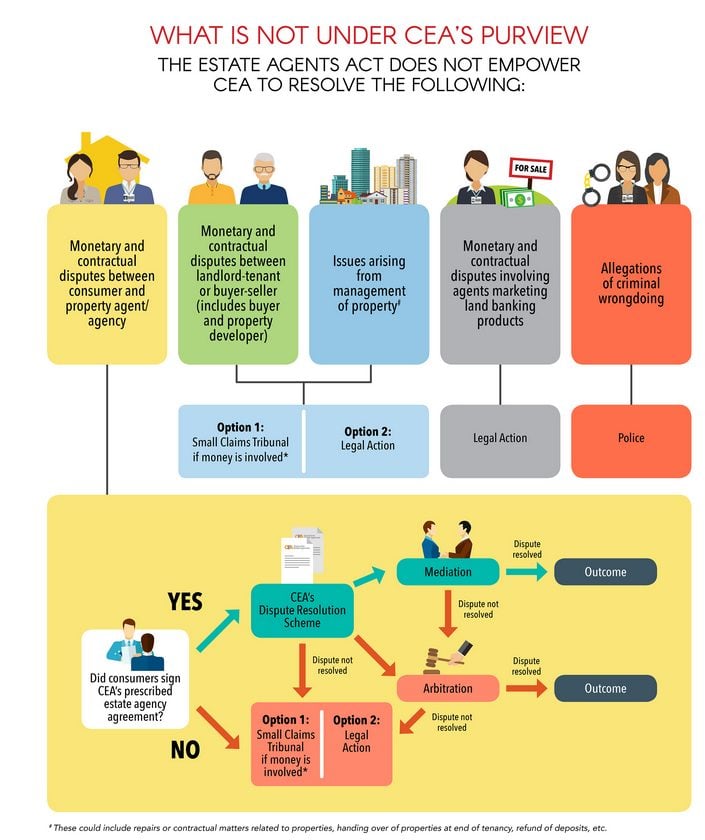
The infographic in the article on the Council of Estate Agencies (CEA) provides a visual representation of the matters that fall under the purview of the CEA and those that do not. To read it, you should first understand that the CEA is a regulatory body for the real estate industry in Singapore. It was established to raise the standard of the real estate industry and hold property agents legally accountable for their actions and duties to their clients.
The infographic is likely divided into two sections. One section lists the issues that the CEA can handle, which may include licensing of estate agents, registration of salespersons, disciplinary actions against errant property agencies and salespersons, and maintaining a public register of property agents. The other section lists the issues that the CEA does not handle, which may include disputes that do not involve a breach of the Estate Agents Act or ethical obligations.
In summary, the infographic serves as a guide for consumers to understand the role and jurisdiction of the CEA. It helps consumers know when and how they can seek help from the CEA, and what issues are beyond the CEA’s control. It is a useful tool for anyone involved in real estate transactions in Singapore to understand their rights and the responsibilities of their property agents.
[For issues on agent commission, read this article.]
Things to bear in mind
When you engage an agent, also be sure to to bear these three golden rules that all property agents are bound by, under the Estate Agents Act:
- Agents are not allowed to hold transaction monies, which are typically held in an escrow account with the conveyancing lawyer;
- Agents are not allowed to refer you to any moneylender (although they can partner with financial institutions for mortgage packages);
- No dual representation; agents are allowed to represent/receive commission from only one party in a transaction; either landlord or tenant; either buyer or seller.
Agents who flout the above can be liable to suspension, revocation, a fine and even jail in serious cases.
Conclusion
The Council of Estate Agencies (CEA) plays a crucial role in regulating Singapore’s real estate industry. Established in 2010, it has successfully raised industry standards and held property agents accountable. The CEA licenses estate agents, registers salespersons, and disciplines errant parties. It also maintains a public register of property agents, providing transparency for consumers.
Furthermore, the CEA offers educational materials and contract templates to help consumers make informed decisions. While it handles complaints against property agencies and salespersons, certain disputes fall outside its jurisdiction. Overall, the CEA is instrumental in upholding the integrity of property transactions in Singapore.
Have a question? Check out CEA’s comprehensive FAQ page or contact them.
Have a property agent you want to recommend? Let us know in the comments below!
If you enjoyed this article, you might be interested in How real estate agents can value-add to their client’s property portfolio and Property agents can now be fined without a disciplinary hearing, says the Government
Frequently Asked Questions
The CEA is a regulatory body established to oversee the real estate industry in Singapore. It licenses estate agents, registers salespersons, disciplines errant parties, and maintains a public register of property agents. The CEA also provides educational materials and contract templates to help consumers make informed decisions.
Consumers can benefit from the CEA in several ways. They can check the public register to verify if a real estate agent is licensed or if a salesperson is registered. They can also see if an agent or salesperson has been disciplined by the CEA in the last two years, if they have received any awards, or if they have closed HDB resale transactions in the last 24 months. Additionally, consumers can use the CEA’s contract templates to compare with real-world contracts they receive.
Yes, the CEA takes consumer complaints against property agencies and salespersons seriously. If a property agency or salesperson has violated the Estate Agents Act or any ethical obligations, a complaint can be initiated. If no law has been broken but there are grounds for dispute, the CEA may arrange for mediation between the two parties under its dispute resolution guidelines. However, certain matters are not under the CEA’s purview, as illustrated in the article’s infographic.
About Marouan Fatti


Looking to sell your property?
Whether your HDB apartment is reaching the end of its Minimum Occupation Period (MOP) or your condo has crossed its Seller Stamp Duty (SSD) window, it is always good to know how much you can potentially gain if you were to list and sell your property. Not only that, you’ll also need to know whether your gains would allow you to right-size to the dream home in the neighbourhood you and your family have been eyeing.
One easy way is to send us a request for a credible and trusted property consultant to reach out to you.
Alternatively, you can jump onto 99.co’s Property Value Tool to get an estimate for free.
If you’re looking for your dream home, be it as a first-time or seasoned homebuyer or seller – say, to upgrade or right-size – you will find it on Singapore’s fastest-growing property portal 99.co.
Meanwhile, if you have an interesting property-related story to share with us, drop us a message here — and we’ll review it and get back to you.
Join our social media communities!
Facebook | Instagram | TikTok | Telegram | YouTube | Twitter





Hello Sir/Madam,
1) I would like to find out if S Pass holder is allowed to do a Housing Agent job post?
2) How many Access Cards to a Condo unit are allowed to be held by a single Housing Agent?
*(Moreover, i’ve seen 1 to 2 of them Holding a Bunch of Accesd Cards, tagged together in a bunch of 15 to 20 by each of the 2 housing agents).
3) Also, 2 of them are not Locals (can see from facial features & spoken language), they are from China.
Above all, as a SG Citizen.. i also have to ensure that there should be NO ILLEGAL HOUSING AGENTS in SG Land.
Thats all for now.
Dear Salim,
1) For foreigners who wish to register with CEA as salespersons, they will need to have a valid Employment Pass (EP) issued by the Ministry of Manpower (MOM).
They should consult an estate agency that is prepared to support their future registration application, who would then check with CEA.
Thereafter, when they register for the RES Course, they will need to produce a letter of sponsorship from the real estate agency.
2) There is no limit/regulations on the number of access cards an agent can hold. If there is an issue, you may want to flag it to the condo management.
3) There’s an increase in the number of non-native Singaporeans becoming property agents. This is largely in line with broader employment trends in Singapore.
I hope the above answers your questions, and the article was of help!
Best Regards,
Kyle Leung
Editorial Lead, 99.co