[2 May 2020 Update: The government has announced that home-based food businesses may resume operations from 12 May onwards. “Home-based food businesses may operate, but only for delivery or collection. Delivery and collection of food orders should be done in a safe and contactless manner, by appointment so that it can be spaced out, and there is no bunching of people,” said the Ministry of Trade and Industry (MTI) in an official statement.]
Yet another controversy has erupted during the Covid-19 circuit breaker period, this time involving home-based businesses. Notices have been put up on Urban Redevelopment Authority (URA) and Housing & Development Board (HDB) websites, which warned home-based business owners that their businesses must abide by circuit breaker measures or face a $1,000 fine.
What the notices say
Under the current circuit breaker measures, postal, courier and door-to-door delivery services are allowed to continue operations as long as safe distancing guidelines are followed. The notices, however, seems to overrule the existing guidelines and introduced a more extreme set of measures for home-based businesses:
- The business should operate solely online, without requiring the business owner(s) and staff to leave their respective homes
- The business does not involve any visitors/customers/third-party delivery services at the premises to collect and/or deliver goods
The notices also state that “if the nature of the home-based business does not meet the stipulated regulations (e.g. home-based F&B businesses), it will need to cease operations.”
Apart from the notices, a advisory has also been jointly issued by the Ministry of Trade and Industry (MTI), the Ministry of Environment at Water Resources (MEWR), URA and HDB that states the above.
The advisory also stated that “enforcement agencies will take firm action against non-compliance. First-time offenders will be issued composition offers of $1,000, and repeat offenders will face higher fines or prosecution in court.”
As of 29 April 2020 noon, the notices on URA and HDB’s page do not refer to the joint advisory.
(According to a check by 99.co, postal, courier and delivery services, including door-to-door, on-demand services such as GogoVan, remain operational.)
Singaporeans react to the advisories targeting home-based businesses
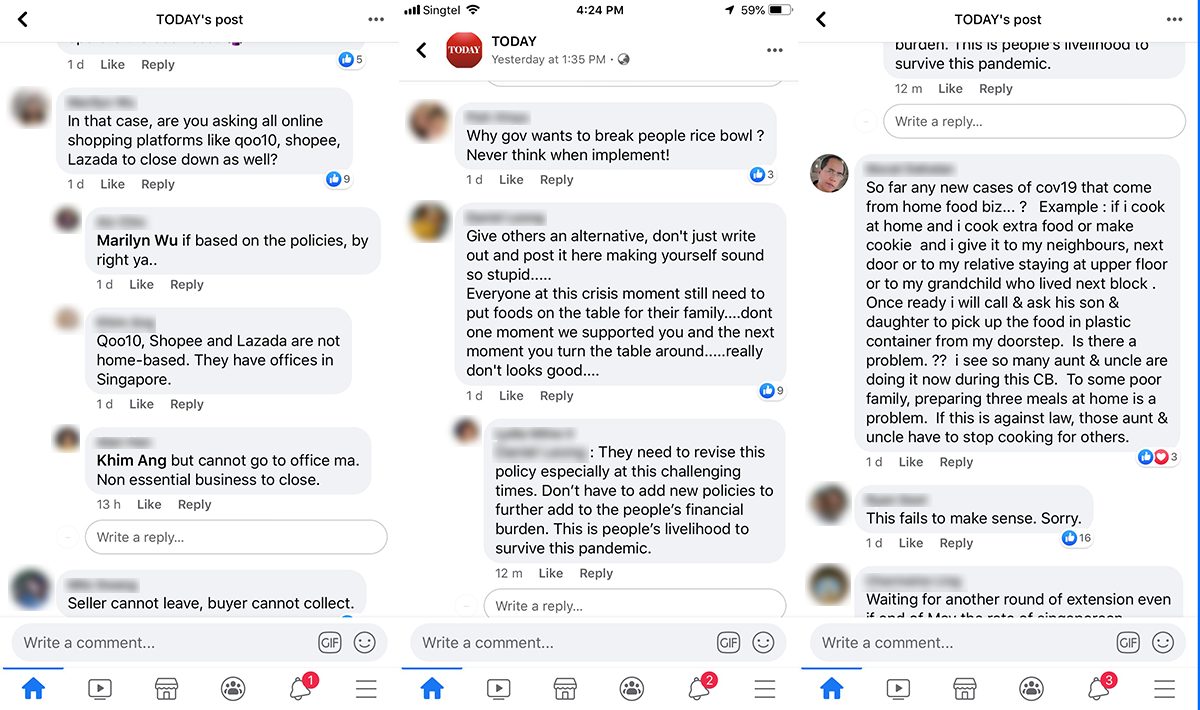
Singaporeans have been quick to note that the newly-announced rules targeting home-based businesses are far stricter and more inflexible than existing circuit breaker rules. They have since made their views known on social media, calling out the authorities for, firstly, setting a double-standard that is prejudiced against home-based businesses, and secondly, for cutting off the financial lifelines of Singaporeans who need it most during the Covid-19 outbreak. (Click/tap to enlarge photos.)
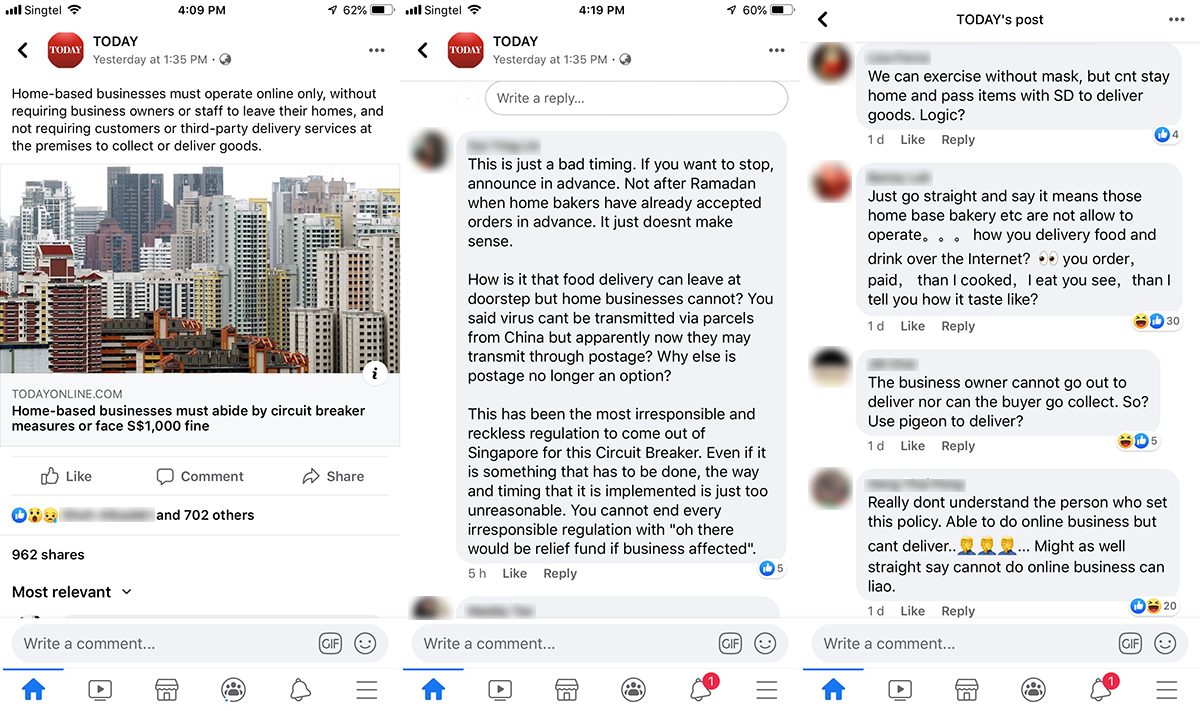
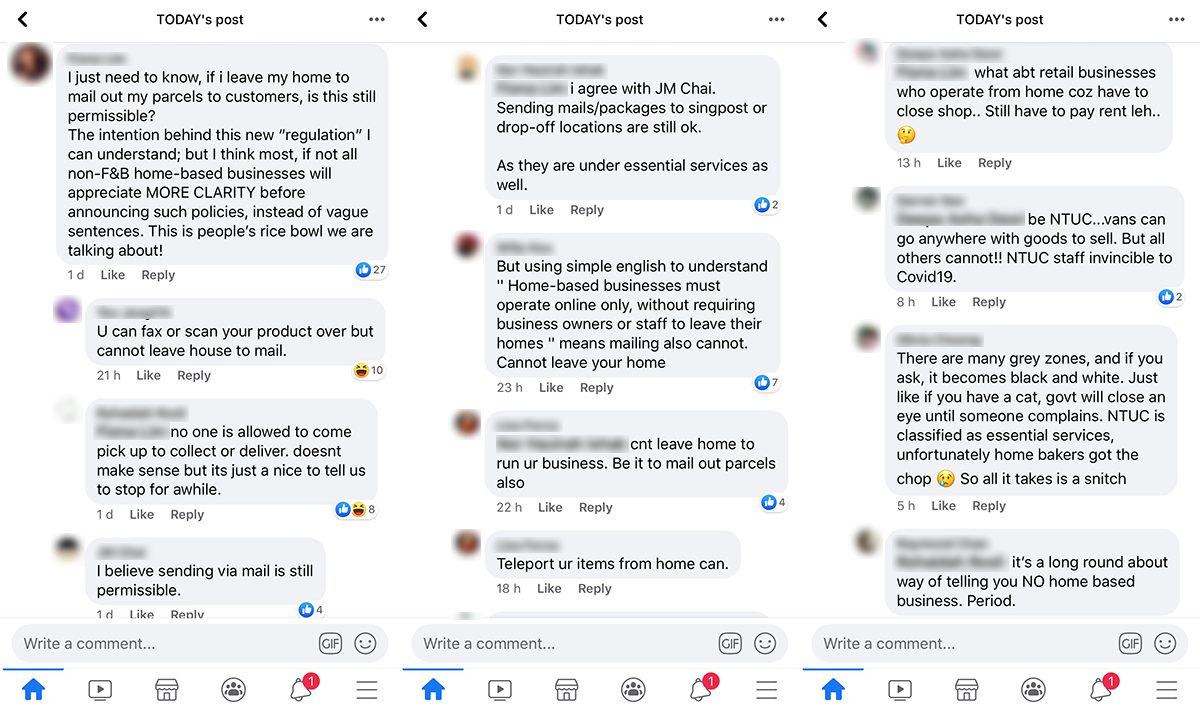
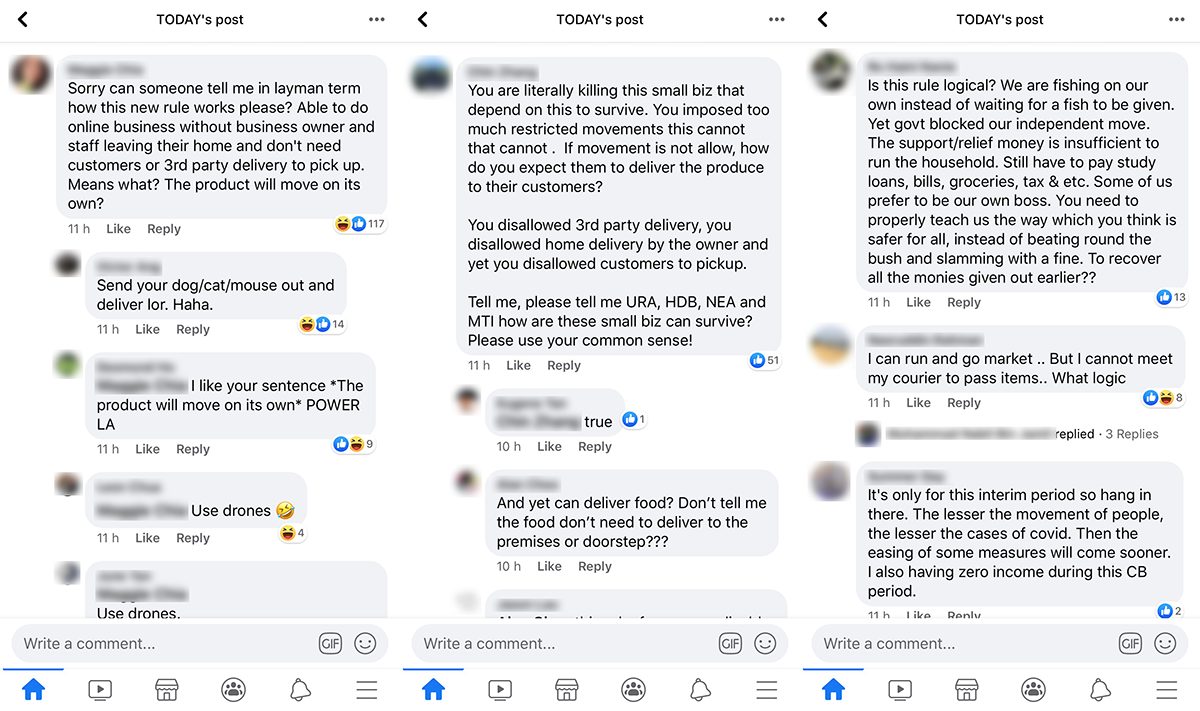
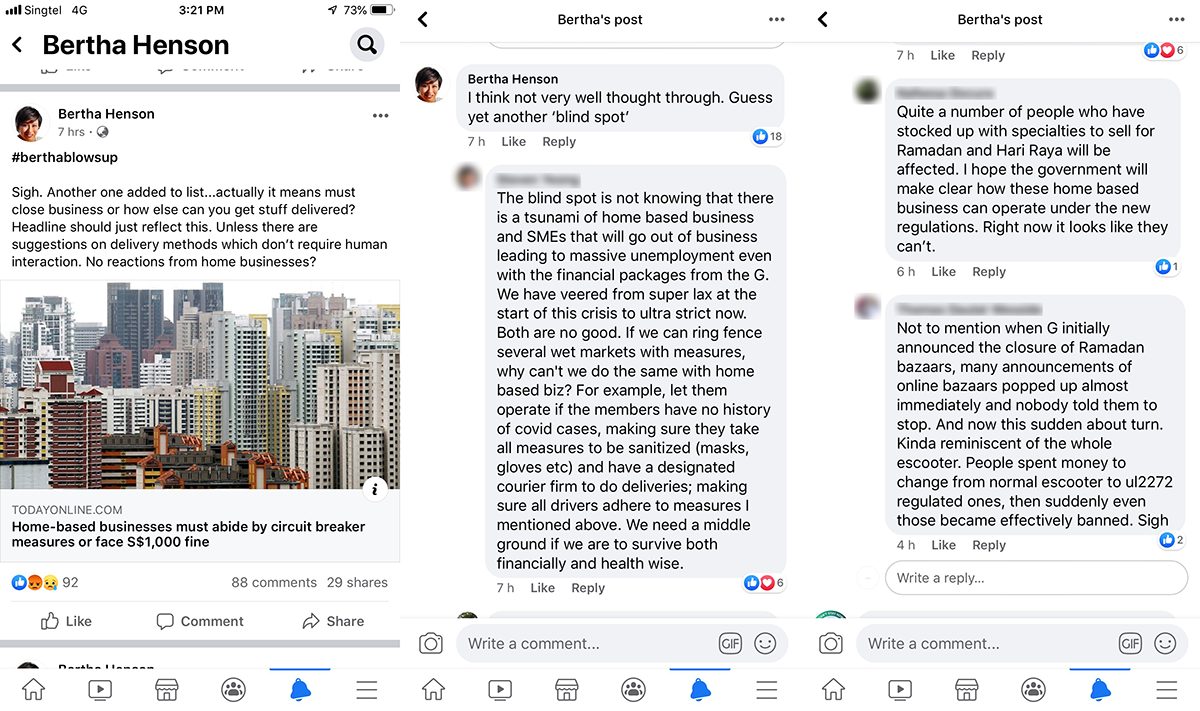
This is the reaction by prominent former Straits Times journalist Bertha Henson, and the comments on her post:
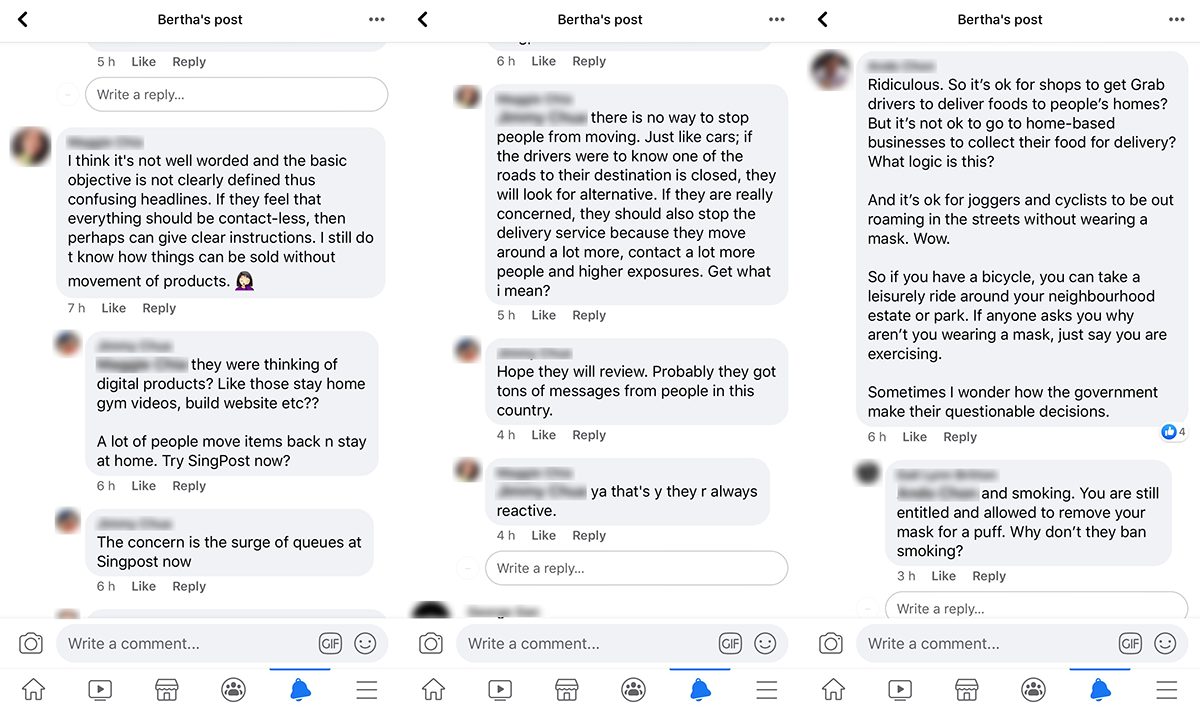
On social media, the tide of public opinion against the advisory is plain to see.
Why was the home-based business advisory not issued at the start of the circuit breaker period?
The local media reported the home-based business advisory on 26 April 2020. Earlier on 24 April 2020, Suria actress Ateeqah Mazlan posted a video on her Facebook account. Ateeqah detailed her contacts with authorities, including the HDB, to find out whether home-based F&B businesses were still allowed to operate after the circuit breaker measures were enhanced on 21st April:
The HDB staff who answered Ateeqah’s call gave a non-affirmative answer to Ateeqah’s queries (although the words “reject” and “not encourage” we’re used in reference to home-based businesses) and suggested she write in using the e-feedback form.
Malay newspaper Berita Herian then picked up on Ateeqah’s video to do their own further checks with the relevant authorities, before releasing an article (in Malay) the day after that clearly stated HDB’s stance on the matter. The URA, which oversees home-based businesses in private properties, also put up a similar notice to the one on HDB’s website.
On 26 April, newspapers Today, Channel NewsAsia and The Straits Times published articles announcing the advisory on home-based businesses and the $1,000 fine that accompanied offenders. Cue uproar.
Ateeqah has since taken down her original video on Facebook, after receiving a barrage of criticisms and fury directed at her for her role in the advisories issued by the authorities.
Petition on advisories gains over 64,000 signatures
A netizen by the name of Nadia Fae has started a Change.org petition, appealing for authorities to allow small home-based F&B businesses to operate on the condition that they comply with circuit breaker rules.
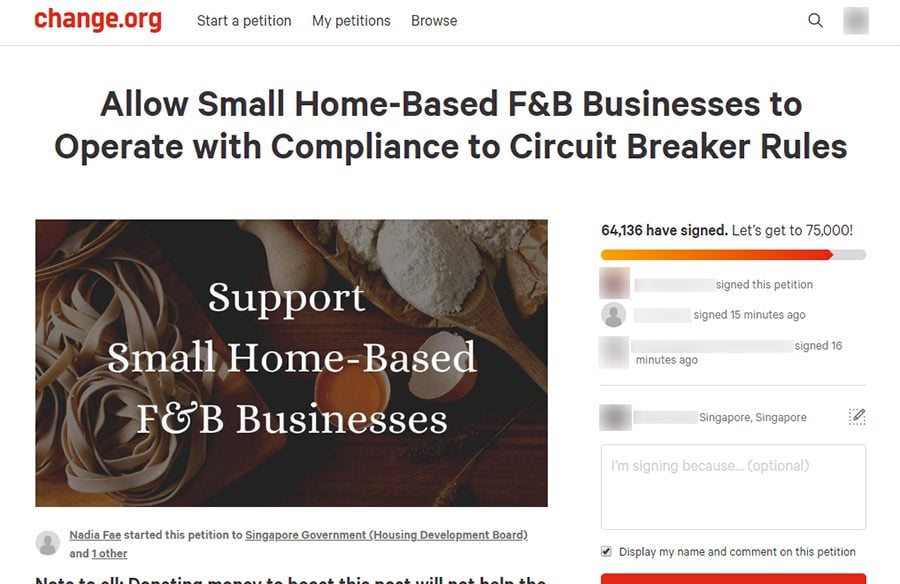
Appealing specifically to HDB to review their stance on home-based businesses, Nadia said on the petition that “we shouldn’t always look to prohibitions and bans as the immediate and best way to handle the spread of the pandemic, especially when it involves the livelihood of small-income families.”
She also claimed that the advisory “is causing a lot more trouble than is being accounted for.” She pointed out that stopping home-based businesses from operating will put families under even more financial constraints as they have to bear the all costs of cooking supplies and ingredients they have already bought with no profits in light of the advisory.
Nadia’s petition has gained over 64,000 signatures at time of writing.
“I’m still dealing with my emotions”
We also got in touch with a home-based business owner, Amy Lim, to find out her reactions to the advisory.
Amy runs Guilt Free Pleasures, a home-based meal-prep business from her four-room Punggol HDB flat. Like most of her counterparts, she was taken back by the advisories.
“I was like, ‘oh my god, so I can’t do this?’,” she recalled. “Then when they came up with the [$1,000] fine I was like: ‘Okay, I need to stop. I can’t make a loss on this.”
After news of the advisories broke, Amy contacted her wholesaler to stop all ingredient deliveries, followed by her customers to cancel their orders. “[My customers were] pretty upset, not with me, but with the system,” she told 99.co right after receiving the latest shipment of ingredients she couldn’t cancel.
Throughout the circuit breaker period, Amy had been observing strict safe distancing measures. “I always use a third-party delivery courier to send my stuff, and I’m not allowing any of my clients to pick up their food during this period,” said Amy, who’s in her 30s.
She added that her “interactions with the courier company is contactless”. “I use only one person to send meals to all locations. I put all the labelled packages ready at the door and the guy picks them up wearing a mask. I tell them to wear a mask and I enforce these standards for myself and also for clients.” she said.
Amy also felt strongly that her home-based business, which delivers a full-week’s worth of meals to customers in one go, should be considered an essential service. “I provide a meal for someone, maybe up to 80% of the meals for a whole week. So this person doesn’t need to go out and buy the food physically somewhere, so in a way I’m helping them stay home and stay safe.”
What is effectively now a ban on home-based businesses is also bad news financially for Amy, who was working full-time in video production until Covid-19 hit. “I kind of lost all my projects,” she said.
Asked if she would appeal for an exemption with the MTI to continue her home-based business, Amy wasn’t sure.
“I am still dealing with my emotions regarding this. I guess I’m afraid of being rejected.”
Stay tuned to 99.co as this story develops
At the time of writing, we have written to URA and HDB for a more detailed clarification of the advisory. We will be publishing any new updates on home-based businesses, so follow us on Facebook.
If you found the article helpful, check out Can I move house during the Covid-19 circuit breaker period? and ‘Massive’ Covid-19 cluster sparks Punggol HDB residents’ worst fears
About Kyle Leung

Content Marketing Manager @ 99.co

Looking to sell your property?
Whether your HDB apartment is reaching the end of its Minimum Occupation Period (MOP) or your condo has crossed its Seller Stamp Duty (SSD) window, it is always good to know how much you can potentially gain if you were to list and sell your property. Not only that, you’ll also need to know whether your gains would allow you to right-size to the dream home in the neighbourhood you and your family have been eyeing.
One easy way is to send us a request for a credible and trusted property consultant to reach out to you.
Alternatively, you can jump onto 99.co’s Property Value Tool to get an estimate for free.
If you’re looking for your dream home, be it as a first-time or seasoned homebuyer or seller – say, to upgrade or right-size – you will find it on Singapore’s fastest-growing property portal 99.co.
Meanwhile, if you have an interesting property-related story to share with us, drop us a message here — and we’ll review it and get back to you.
Join our social media communities!
Facebook | Instagram | TikTok | Telegram | YouTube | Twitter



No. We can’t allow hb business without sufficient restrictions. We are all affected. Government had provided helps to overcome some of these hurdles. Allowing hb business to run as normal business has ripple effect on the economy. After the circuit breaker how will these business be? Will they agree to be revert to before the circuit breaker ways?
Yes, restriction should be lift. Rather than giving help to tide over the situation, these HB is a self help way if done correctly.
We should encourage more entrepreneur in such severe situation.
Now is only the initiate phase. We have to prepare to face a new world after the covid-19 is resolved with new found vaccine. We will find a new equilibrium in how we go about life vastly different form the past.
I find the official advisory on HDB’s page ambiguous. Let me break it down this say.
1) Home-based businesses can continue as long as they meet “the latest provision under the COVID-19 (Temporary Measures) Act 2020”.
2) FOR EXAMPLE, if it meets conditions A, B and C (which people are arguing over).
3) If your home-based business does not meet THE stipulated regulations, then stop.
Have you noticed that 1) and 3) does not refer to 2)? If they did, 2) should say “including” and 3) should say THESE stipulated regulations. They have referenced regulations but not given a direct link to them. Instead, they’ve listed 3 new rules that appear to be separate from the general regulations as issued by the government.
HDB is saying, your HBB must work within the guidelines set by other committees. When you call MTI for clarification, they say HDB is imposing their own extra rules, please follow them. All online retail are actually classified as essential services (https://covid.gobusiness.gov.sg/essentialservices/others/). So now HDB is contradicting general MTI guidelines with a set of 3 guidelines that they have implied to be part of the general guidelines.
As it happens, these 3 new guidelines are draconian and odd. As others have pointed out, they make little sense when the general population is still able to leave the home for various other activities. If you’ve made calls to different government agencies as I have, you’ll find that there was no concerted effort to implement these new rules at all. I hope HDB realise the confusion they’ve created through lacklustre wording and make a definitive statement once and for all.