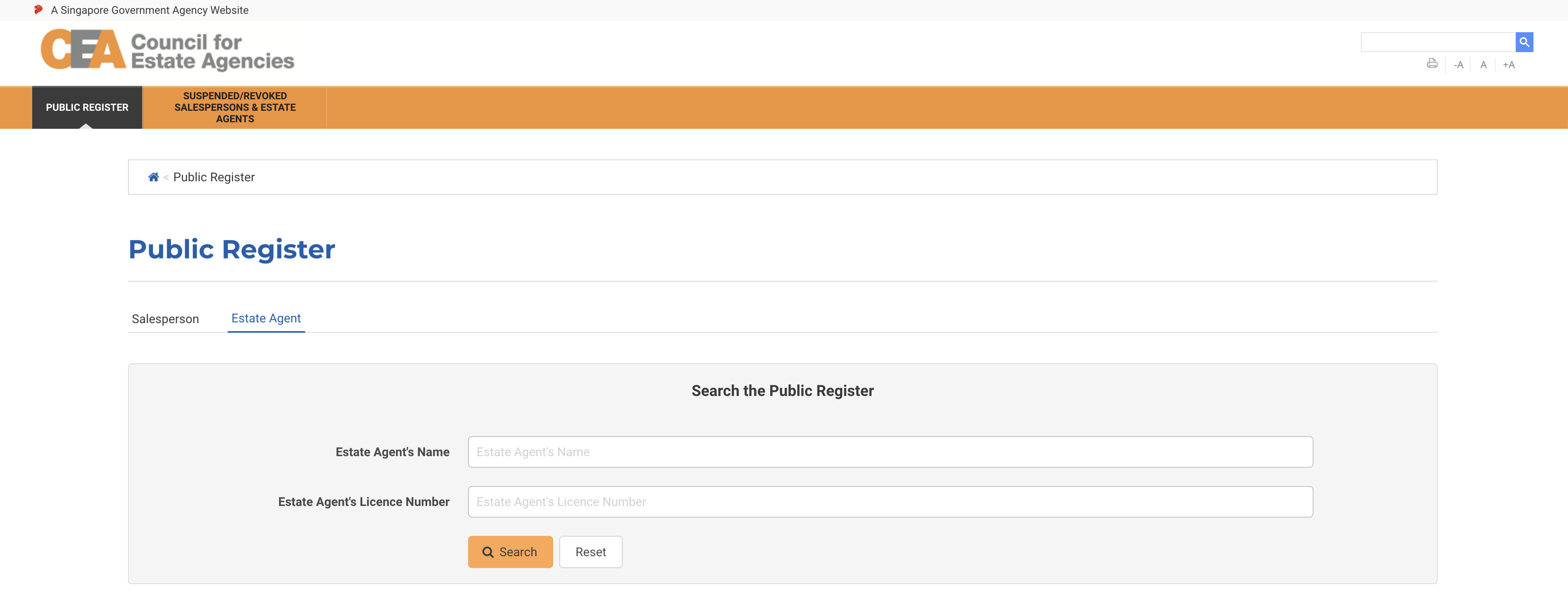
The Council for Estate Agencies (CEA) recently upgraded its website, which is awesome. Previously, we only went there to check whether a property agent’s license is real and not, say, a string of numbers made up by a nervously sweating man who wants the down payment in iTunes gift cards. Starting this month, you can not only check the property agent’s license, but their record of HDB resales as well. Here’s what to look for:

What sort of information can we see?
The CEA Public Register will now show details of completed HDB resale transactions when you search for a property agent. This includes information on the transaction dates, the location of the flat, and who the agent represented (buyer or seller). Do note that the information will only date back to the last 24 months.
(If you need older information, you’ll need to sift through the Singapore government’s public data site).
CEA is continuing to develop the site to include details of successful rental transactions, as well as private property transactions.
This solves an old problem for home buyers: Property agents’ licenses are convenient to check. Their sales history is not. Sure, you could ask their real estate agency – but you’ll probably get a dressed-up answer (e.g. “He’s our most experienced closer!”)
What should you be looking for in that reel of block / unit names?
These are the three main things to look for, but there’s other important things to note:
- How active the property agent has been
- (Later in the year) the type of housing the property agent specialises in
- The property agent’s neighbourhood of choice
And finally, do some good ol’ Googling for the agent’s name, and the various transactions.
1. How active the property agent has been
A property agent can be inactive for two years before rejoining the industry. This will, of course, show in their transaction records.
Now there’s nothing inherently wrong with a property agent whose been inactive – lots of people leave the industry for a period and then come back. Whenever there’s cooling measures, the market looks like mammal migrations in the Serengeti: thousands stampede to get out, and stampede back when the market recovers.

But many buyers prefer agents who have been active and in-touch. Also, if a property agent has been actively closing deals even during “bad” years, that’s often a sign that they’re true, lifelong career professionals.
2. (Later in the year) The type of housing the property agent specialises in
For now, all you can see are resale flat transactions. But once the system is ready in the second half of this year, you’ll also be able to see rental and private property transactions.
This clues you in on whether the property agent has relevant experience, rather than just experience.
For example, some agents – such as relocation experts – deal almost exclusively with helping landlords find tenants, or vice versa. Some may even go years without helping anyone buy or sell a house. If you’re looking to sell, they may not be your top choice; but they definitely are if you’re struggling with a vacant asset.
3. The property agent’s neighbourhood of choice
You should take note of where a property agent closes deals. We know that size wise, Singapore’s the geographic equivalent of a pimple on an elephant’s back; but agents still need hyper-local knowledge.
For example, you want the property agent who can tell you a minimart at a given block sells Maggi Mee for 30 cents less than the one two streets across; or that a particular block is problematic because a teenage gang frequently hangs out around the void deck, doing dangerous things like trading Pokemon cards.
It’s this knowledge of minute details that makes a property agent useful, especially to buyers; so check that the property agent has a lot of dealings in the relevant neighbourhoods.
Finally, there’s one thing you have to look for that you can’t find on the CEA site. That’s to…

4. Google the property agent’s name, and the various transactions
This is a simple step that many first-time home buyers / sellers forget. Put your sleuth cap on and Google the agent (and the various transaction by address) to pull up news of outstanding performance, problematic transactions, or other such details.
For example, a search might reveal that a property agent is the person behind a million-dollar flat sale a few years ago; or it might reveal complaints about serious problems with a property (that doesn’t speak well for a property agent that represented the buyer).
Remember, a 10 minute search can prevent decades of rage and disappointment after you buy or sell.
What sort of information would you like to know about your property agent? Voice your thoughts in our comments section below.
If you enjoyed this article, 99.co recommends 7 things you need to consider before buying a home, and 5 important HDB schemes Singaporeans might have no idea about.
About Ryan Ong


Looking to sell your property?
Whether your HDB apartment is reaching the end of its Minimum Occupation Period (MOP) or your condo has crossed its Seller Stamp Duty (SSD) window, it is always good to know how much you can potentially gain if you were to list and sell your property. Not only that, you’ll also need to know whether your gains would allow you to right-size to the dream home in the neighbourhood you and your family have been eyeing.
One easy way is to send us a request for a credible and trusted property consultant to reach out to you.
Alternatively, you can jump onto 99.co’s Property Value Tool to get an estimate for free.
If you’re looking for your dream home, be it as a first-time or seasoned homebuyer or seller – say, to upgrade or right-size – you will find it on Singapore’s fastest-growing property portal 99.co.
Meanwhile, if you have an interesting property-related story to share with us, drop us a message here — and we’ll review it and get back to you.
Join our social media communities!
Facebook | Instagram | TikTok | Telegram | YouTube | Twitter





Leave a comment