
Buying a property can be daunting and complicated, especially if it is your first time. On the financial side, it is not just the home loan that you need to take note of. There are other (often hidden) things to consider, such as the stamp duty and property tax.
For Singaporeans, if it is their first home, they are exempted from paying the Additional Buyer’s Stamp Duty (ABSD).
But it is a different story for those buying with a PR or foreigner. Even if it is their first residential property, they are still subjected to the ABSD.
What is ABSD?
The Additional Buyer’s Stamp Duty (ABSD) is a stamp duty paid on top of the Buyer’s Stamp Duty (BSD). The payable rate depends on the residential status of the buyer and the number of residential properties under their name. How much you will need to pay is then computed based on the property price or valuation, whichever is higher.
It is a cooling measure designed to bring down property prices and make housing more affordable for Singaporeans. So the ABSD rates are higher for non-Singaporeans and those with more than one residential property.
The latest change in the rates took effect on 27 April 2023, almost 1.5 years after the previous hike in December 2021. The ABSD rate for Singaporeans was increased from 17% to 20% for their second residential property.
| ABSD rate from 16 December 2021 to 26 April 2023 | ABSD rate from 27 April 2023 | Increased by | ||
| Singapore citizens | First residential property | 0% | 0% | – |
| Second residential property | 17% | 20% | 3% | |
| Third and subsequent residential property | 25% | 30% | 5% | |
| Permanent Residents (PR) | First residential property | 5% | 5% | – |
| Second residential property | 25% | 30% | 5% | |
| Third and subsequent residential property | 30% | 35% | 5% | |
| Foreigners^ | Any residential property | 30% | 60% | 30% |
| Entities | Any residential property | 35% | 65% | 30% |
| Trustees | Any residential property | 35%* | 65% | 30% |
| Housing developers | Any residential property | 35% (remittable) + 5% (non-remittable) | 35% (remittable) + 5% (non-remittable) | – |
*The ABSD rate for trustees was from 9 May 2022 to 26 April 2023.
^Excluding Nationals and Permanent Residents of Iceland, Liechtenstein, Norway, and Switzerland, and Nationals of the United States of America, who will be subject to the same stamp duty rate as Singaporeans.
For PRs buying their second residential property, the increase was even higher from 25% to 30%. It is even steeper for foreigners, as the ABSD rate has been doubled from 30% to 60%.
The thing about the ABSD is that if you are buying with another person with a different profile (that is, based on the number of residential properties owned and residency status), the ABSD payable will be based on the profile with the higher ABSD rate.
The exception to this is for buyers who are:
- Nationals or Permanent Residents of Iceland, Liechtenstein, Norway, or Switzerland
- Nationals of the United States of America
Under the respective Free Trade Agreements (FTAs), they will enjoy the same stamp duty rate as Singaporeans. They can apply for the remission via the e-Stamping Portal.
Navigating the intricacies of ABSD in Singapore’s property market
Purchasing property in Singapore comes with its unique set of challenges and regulations, especially with the Additional Buyer’s Stamp Duty (ABSD). Introduced as a cooling measure to stabilise property prices and ensure housing affordability for Singaporeans, the ABSD is a crucial factor to consider for both local and foreign buyers.
While Singaporeans buying their first home are exempted, the rules differ for Permanent Residents (PRs) and foreigners. The rates are also influenced by the number of properties owned and have recently undergone changes. With the latest revision in April 2023, understanding the nuances of ABSD becomes even more vital for potential buyers.
Here’s a breakdown of how the ABSD can affect your home purchase.
SC/PR buyers
Buying a first house together
For PRs, whether they are buying their first residential property on their own or jointly with a Singapore Citizen (SC), they will need to pay 5% ABSD.
So if you are a Singaporean planning to buy a house with a PR, and this is the first residential property for both of you, you will need to pay the 5% ABSD.
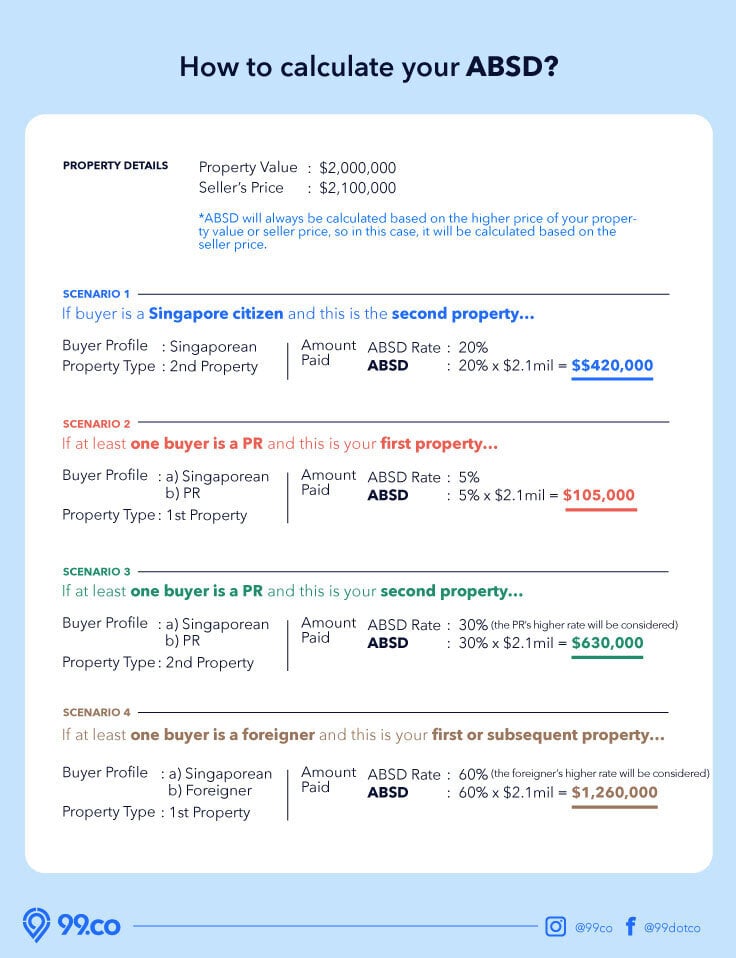
Let’s say you are buying a S$2.1 million condo. The ABSD to be paid will be 5% ⨉ S$2.1 million = S$105,000.
SC owns one house before the joint purchase
Where the SC already has a house, the joint purchase with the PR will be considered being the SC’s second home purchase.
This means SC’s ABSD rate will be 20%, while the PR’s ABSD rate is 5%.
The ABSD payable will be the higher rate, with the SC’s rate at 20%. This translates to an ABSD of S$420,000 for a S$2.1 million condo.
Use 99.co’s stamp duty calculator to calculate how much ABSD to pay!
PR owns one house before the joint purchase
If it is the PR that already has a house, the joint purchase will be the PR’s second home purchase. So they are subject to the 30% rate.
For a S$2.1 million condo, the SC-PR buyer will have to pay an ABSD of S$630,000.
Condos for sale at S$2.5m and below

 2
2
 2
2
 2
2
2
2
 5
3
5
3
 1
1
1
1
 2
1
2
1
 1
1
1
1
 3
2
3
2
 3
2
3
2
 2
2
2
2
 1
1
1
1
 1
1
1
1
 2
2
2
2
 2
1
2
1
 1
2
1
2
 2
2
2
2
 2
2
2
2
 2
2
2
2
 2
2
2
2
 3
2
3
2
 4
2
4
2
 2
2
2
2
 2
2
2
2
 2
2
2
2
 1
1
1
1
 4
4
4
4
 2
2
2
2
 2
2
2
2
 2
2
2
2
 2
2
2
2
 1
1
1
1
 2
2
2
2
 2
2
2
2
 1
1
1
1
 1
1
1
1
 2
2
2
2
 2
2
2
2
 2
1
2
1
 2
3
2
3
 1
1
1
1
 1
1
1
1
 2
2
2
2
 2
1
2
1
 3
2
3
2
 4
4
4
4
 1
1
1
1
 2
2
2
2
 3
3
3
3
 2
2
2
2
 2
2
2
2
 2
2
2
2
 3
2
3
2
 2
2
2
2
 4
3
4
3
 3
1
3
1
 2
2
2
2
 2
2
2
2
 1
1
1
1
 1
1
1
1
 2
2
2
2
 2
2
2
2
 0
1
0
1
 2
2
2
2
 1
2
1
2
 1
1
1
1
 3
2
3
2
 1
1
1
1
 3
1
3
1
 3
2
3
2
 2
2
2
2
 3
3
3
3
Buying a second house together
Let’s say you and another person (a PR) have a residential property on your own, and plan to buy another house together.
As of 27 April 2023, the ABSD for SCs buying a second home is 20%. For PRs buying a second home, it’s 30%.
Here, the payable rate will follow the PR’s rate, which is 30%.
So for a S$2.1 million condo, the ABSD rate payable is 30% ⨉ S$2.1 million = S$630,000.
This table from IRAS summarises the ABSD rate for SC/PR buyers, based on the number of residential properties owned and residency status.

The impact of ABSD on joint property purchases
Joint property purchases, especially between Singaporeans and PRs or foreigners, bring additional considerations regarding ABSD. The rate applied is based on the profile of the higher ABSD rate, which can significantly impact the overall cost of the property. For instance, a joint purchase between a Singaporean and a PR for a second home would attract the PR’s higher rate.
There are exceptions and remissions available, such as the ABSD remission for married couples, which can provide relief from these duties. However, eligibility criteria, such as the need for at least one Singaporean spouse, apply. As the property landscape in Singapore continues to evolve, being well-informed about these regulations can make the buying process smoother and more predictable.
SC/Foreigner buyers
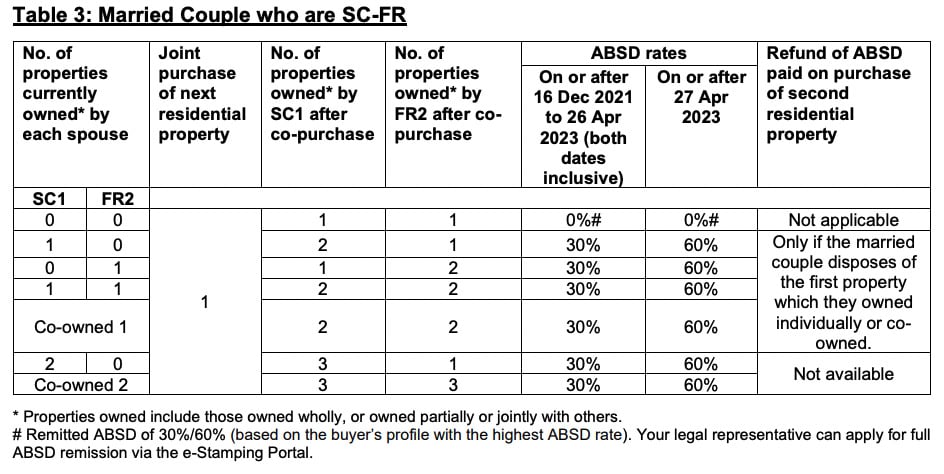
Whether it is the first home purchase or not, foreigners have to pay a 60% ABSD, as of 27 April 2023. This is an increase from 30%.
On top of that, since the highest ABSD rate for SCs is 30% (for the third and subsequent home purchase), the ABSD rate payable for a joint purchase with a foreigner will follow the foreigner’s rate of 60%.
A S$2.1 million condo, the ABSD payable is 60% ⨉ S$2.1 million = S$1,260,000.
This table summarises the ABSD rate for SC/foreigner buyers, based on the number of residential properties owned and residency status.
The good news is that if you are buying as a married couple, you may be eligible for the ABSD remission.
ABSD remission for married couples
With the ABSD remission, you can either apply not to pay the ABSD or get a refund (more on this later). But you will need to meet certain criteria. The main thing is that the house has to be:
- Bought jointly by a married couple
- Married couple comprises at least one Singaporean
[xyz-ihs snippet=”Property-Value-Widget-Code”]
Buying a first home together
Let’s say you are a Singaporean and your spouse is a non-Singaporean (either a PR or foreigner). If you and your spouse do not have any other residential properties, you can apply for the ABSD remission. So you do not have to pay the ABSD.
You can apply for the ABSD remission via the e-Stamping Portal.
But the main thing is both of you must buy the house together.

Buying a second house to upgrade
If you and your non-Singaporean spouse are buying a second house together to upgrade (for instance, from an HDB flat to a condo), you will be subjected to a higher ABSD rate.
This will be 30% on the second house if your spouse is a PR, or 60% if they are a foreigner.
You will have to pay the ABSD first, even if you plan on selling the first home.
If you sell it within six months from:
- the date of purchase for a completed property (eg. a resale condo), or
- the TOP or CSC date (whichever is earlier) for an uncompleted property (eg. new launch condo)
you may be eligible for the ABSD remission to get a refund.
Likewise, to be eligible for the remission, the second residential property must be purchased under both names.
You can apply for the remission through the e-Stamping portal. For more information on the refund application for the ABSD remission, you can also refer to IRAS’ guide.

What else to take note of about the ABSD remission?
Not applicable for HDB flats and new ECs
ABSD remission does not apply if you are upgrading from an HDB flat to another HDB flat, e.g. from a 4-room to a 5-room flat. Or if you are upgrading to a new EC bought from the developer.
After all, for public housing and ECs bought from developers, dispose of your old flat within six months of the sale completion (i.e. getting the keys to the flat).
5
3
3
2
3
2
4
2
 3
2
3
2
 3
2
3
2
 4
3
4
3
 4
3
4
3
 4
2
4
2
 4
3
4
3
Not applicable for third property onwards
The ABSD remission is only for buying the first property, or the second property, if you sell the existing property.
So if you are buying a third property together, pay the ABSD and cannot get a refund.
For an SC/PR couple, the ABSD rate will be 35%. SC/foreign couples will be subject to the 60% ABSD rate.
Only for married couples
Even if you are engaged, you will not be eligible for the ABSD remission.
The ABSD has to be paid within 14 days of signing the Option to Purchase (or Sale and Purchase Agreement if no OTP is issued). So if you want to qualify for the ABSD remission, register your marriage beforehand.
This also means that if you are planning to buy a house with your parents or siblings, you will not qualify for the remission.
Only for married couples with at least one SC
This is one of the first things we mentioned about the ABSD remission, but we thought we should highlight it here again.
The ABSD remission only applies for those with at least one Singaporean spouse. So it is not applicable for PR-foreigner couples.
And given that the ABSD rate to pay will be based on the profile with the higher rate, regardless if this is the first residential property together or the third one together, the ABSD payable will be 60%.
ABSD for joint property purchases
When considering a joint property purchase in Singapore, particularly with a PR or foreigner, understanding the Additional Buyer’s Stamp Duty (ABSD) implications is crucial. The payable rate is determined by the profile with the higher ABSD rate, which can significantly affect the overall cost.
For example, a Singapore citizen buying a second home with a PR will face the PR’s higher rate if it is their second property. This can lead to substantial additional costs, as illustrated by the 30% ABSD rate for PRs buying their second home. Staying informed about these nuances helps in better financial planning and avoiding unexpected expenses during property transactions.
Utilising digital tools for ABSD calculations and remissions
Using digital tools and resources can help manage the complexities of ABSD. The IRAS e-Stamping Portal allows for the calculation of stamp duties and streamlines applying for ABSD remission, particularly for eligible married couples.
Property platforms like 99.co provide stamp duty calculators and comprehensive guides to navigate the real estate landscape in Singapore. These tools can simplify the buying process, ensuring that both local and foreign buyers are well-prepared to handle the financial and regulatory aspects of their property investments.
Planning to sell your house soon? Let us help you get the right price by connecting you with a premier property agent.
If you found this article helpful, 99.co recommends Additional Buyer’s Stamp Duty (ABSD) in Singapore, explained (2023) and Buying a property in Singapore as a foreigner.

About Virginia Tanggono

Virginia covers the property news in Singapore, from record sales to profile stories on home ownership. In her free time, she occasionally searches for spoilers of movies and TV shows.

Looking to sell your property?
Whether your HDB apartment is reaching the end of its Minimum Occupation Period (MOP) or your condo has crossed its Seller Stamp Duty (SSD) window, it is always good to know how much you can potentially gain if you were to list and sell your property. Not only that, you’ll also need to know whether your gains would allow you to right-size to the dream home in the neighbourhood you and your family have been eyeing.
One easy way is to send us a request for a credible and trusted property consultant to reach out to you.
Alternatively, you can jump onto 99.co’s Property Value Tool to get an estimate for free.
If you’re looking for your dream home, be it as a first-time or seasoned homebuyer or seller – say, to upgrade or right-size – you will find it on Singapore’s fastest-growing property portal 99.co.
Meanwhile, if you have an interesting property-related story to share with us, drop us a message here — and we’ll review it and get back to you.
Join our social media communities!
Facebook | Instagram | TikTok | Telegram | YouTube | Twitter

Leave a comment