

(Credits)
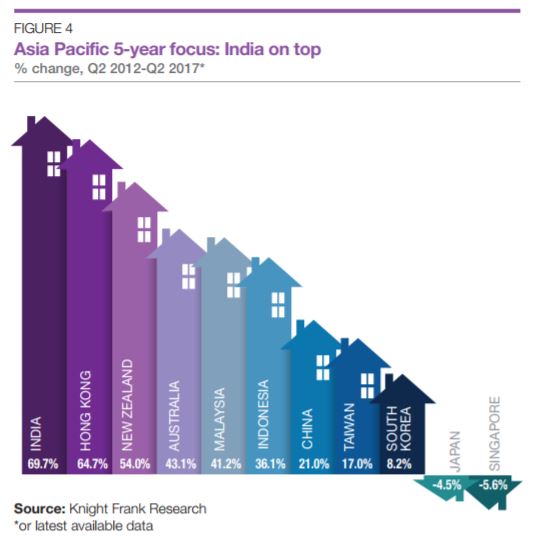
If you’re thinking of investing in a property overseas, pay attention: the latest global property index has just been released, and this shows that house prices in key countries around the world increased by an average of 5.6% in the year thus far. Leading the pack is Iceland, which has seen a whopping 23.2% increase in property prices; Singapore’s prices have fell by 2.1% in the last year, and 5.6% in the last five years.
(Credits)
Over the last five years, property prices have risen significantly in the Asian Pacific region, especially in India, Hong Kong, and New Zealand. Hong Kong, in particular, has consistently been and still is Asia’s strongest performing market over a 12-month period – this is in spite of the three interest rate rises which the country has seen last year. According to experts, propping up the high property prices in Hong Kong is the strong demand fuelled by both local Hong Kong residents, and mainland Chinese investors who are trying to hedge against the yuan’s depreciation.
Property prices plateauing
Given that Hong Kong has seen its property prices climb up 21.1% in the past 12 months, it isn’t the right opportunity for investors who are hoping to buy low and sell high. That having been said, however, investors might want to consider looking to the other countries whose quarterly increases in property prices are somewhat petering out.
Take China, for example – whilst the country had a 9.6% increase in property prices in the last 12 months, this dipped to a 3.4% and 2.1% increase in the last 6 months and 3 months respectively. The same goes for Australia, which saw a 10.2% increase in property prices over the last year, but only a 6.4% and 2.2% increase in the last 6 and 3 months.
Buying property overseas – taking a closer look at China

(Credits)
The good news? China has done away with their policy which states that a foreigner who wishes to purchase real estate needs to have worked or studied in the country for at least a year. The bad news? Foreigners who want to buy property in China need to actually live in China.
What does this mean? If you’re pretty much settled in Singapore and don’t wish to uproot yourself, China is out of the question for you. But if you have any sort of business dealings in China which require you to be there for long periods of time, then you might be able to go ahead and purchase property. It’s not too tough for foreigners to get financing at 70% loan-to-value ratio; additional taxes and costs include stamp duty, deed tax, and having your sales contract notarised.
Buying property overseas – zooming in on Australia

(Credits)
Fancy owning a property down under? Purchasing real estate in Australia is significantly easier than in China. For non-residents, though, you’re restricted to only buying property if you “add to the property market”. This means that you can only purchase new dwellings, off-the-plan properties under construction, or vacant land (with the intention to develop it further). If you’re thinking of buying an established dwelling, this isn’t allowed unless you’re planning to demolish it and construct a new home within 4 years of the date of approval.
When it comes to the application process, this is fairly straightforward. Applications to buy new dwellings are usually approved right off the bat, but when it comes to applications to buy vacant land for development purposes, these are subject to the timeframe in which you’re intending to start construction, amongst other things.
Buying property overseas involves a significant amount of risk, so be sure you read up and cover all your bases before making any big decisions. Check out our articles on the Forest City debacle: 4 lessons to learn buying overseas property, Singaporean investors losing millions to fraudulent property company and Overseas property loans in Singapore for more property investment tips!
About Elizabeth Tan

Elizabeth is a writer, a Harry Potter fanatic, and a Game Of Thrones addict.

Looking to sell your property?
Whether your HDB apartment is reaching the end of its Minimum Occupation Period (MOP) or your condo has crossed its Seller Stamp Duty (SSD) window, it is always good to know how much you can potentially gain if you were to list and sell your property. Not only that, you’ll also need to know whether your gains would allow you to right-size to the dream home in the neighbourhood you and your family have been eyeing.
One easy way is to send us a request for a credible and trusted property consultant to reach out to you.
Alternatively, you can jump onto 99.co’s Property Value Tool to get an estimate for free.
If you’re looking for your dream home, be it as a first-time or seasoned homebuyer or seller – say, to upgrade or right-size – you will find it on Singapore’s fastest-growing property portal 99.co.
Meanwhile, if you have an interesting property-related story to share with us, drop us a message here — and we’ll review it and get back to you.
Join our social media communities!
Facebook | Instagram | TikTok | Telegram | YouTube | Twitter





Leave a comment