Calculating leasehold property values has always been a headache, anywhere in the world. How do you work out the value between a property with 60 year’s lease remaining, versus one with 50 years left?
To make life easier (and fairer) in Singapore, organisations like the Singapore Land Authority (SLA) use a leasehold value table, based on a tried-but-true guideline called Bala’s Curve.
Who is Bala? What is his curve/table?
Way back when Singapore was still a British colony, the Land Office needed to work out the fees for alienation of the land (by alienation, I mean “renting out” state land to private entities for long periods.
At around that time, it is widely believed that a Land Office employee named Bala proposed a table (also called Bala’s Curve in graph form), which acted as a guideline for the price of renting out state land. Over time, Bala’s Table/Curve made its way to the real estate market. It also became tangential to its original intent and became a guide point on valuations for leasehold land against leasehold value.
This adaptation of Bala’s Curve to work out leasehold land values is believed to have come about in 1947, when the colonial administration decided they would start handing out 99-year leases instead of further freehold titles.
The SLA’s leasehold value table follows Bala’s Curve. This was made public in July 2000, so we know for a fact that the government uses this method to assess land values. It directly affects what developers pay in terms of Development Charges (DCs), differential premiums, and the cost of topping up the lease in an en bloc transaction.
Let’s say a developer has set eyes on a 39-year-old leasehold development for en bloc sale. The land would be valued at S$50 million if it were freehold. Its leasehold value (80% of freehold value) is thus S$40 million, using Bala’s Curve. To top it back up to 99 years (96% of freehold value), the developer would have to pay an additional S$8 million (S$48 million – S$40 million).

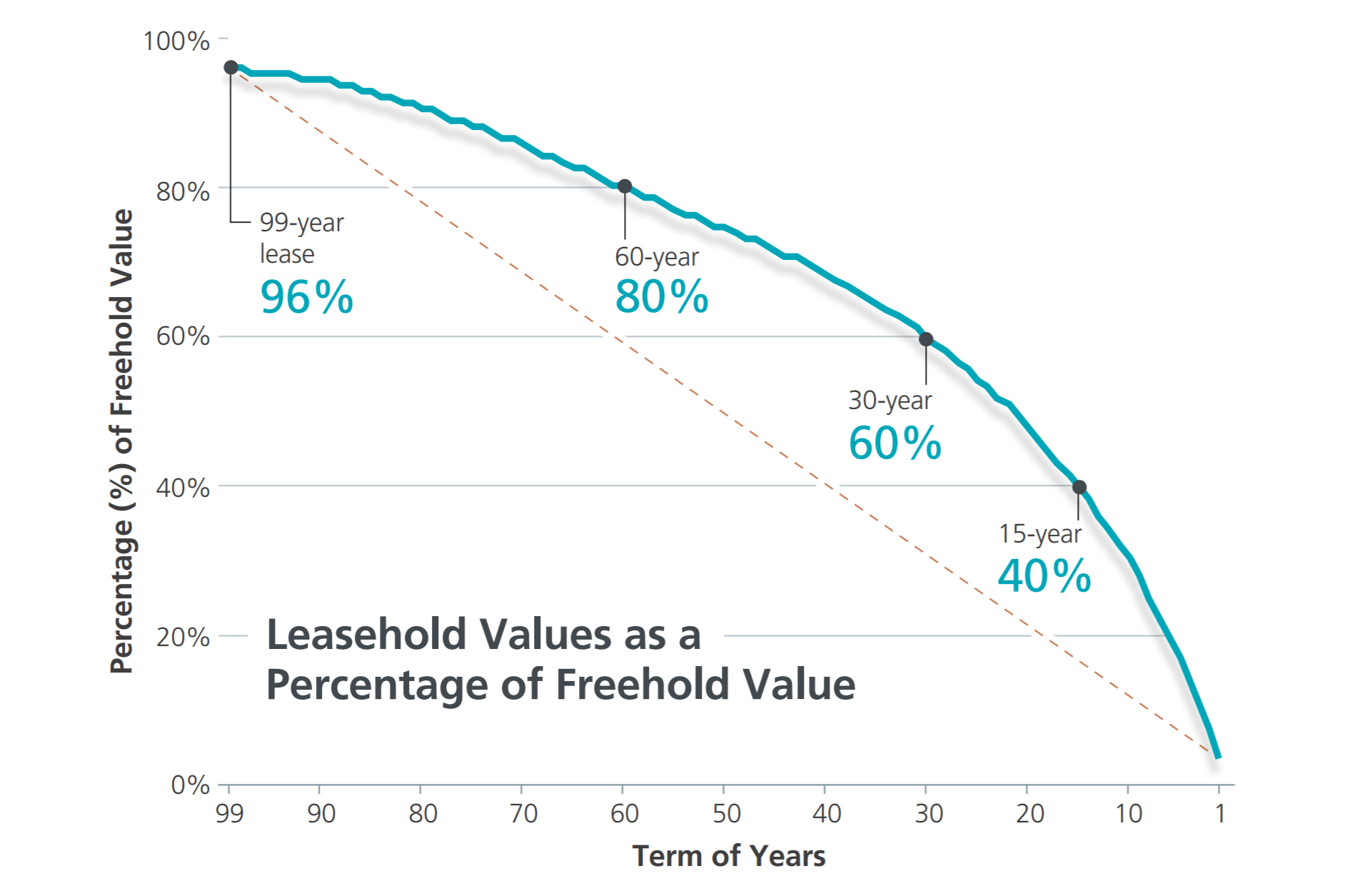
A simplified look at how Bala’s Curve works:
On the curve, the value of leasehold land is expressed as a percentage of the land value were it freehold. For example, consider a property that would be worth S$1 million as a freehold:
- At the start of a fresh 99-year lease, the value of a property is 96% of its freehold value. So if it would hypothetically be worth S$1 million as a freehold property, the actual value of the leasehold property, in reality, is S$960,000.
- When there are 60 years left on the lease, it is worth 80% of its freehold value—so S$800,000 as a leasehold
- When there are 30 years left on the lease, it is valued at 60% of its freehold value, or S$600,000
Here’s Bala’s Curve:
Here it is in table form, from SLA:
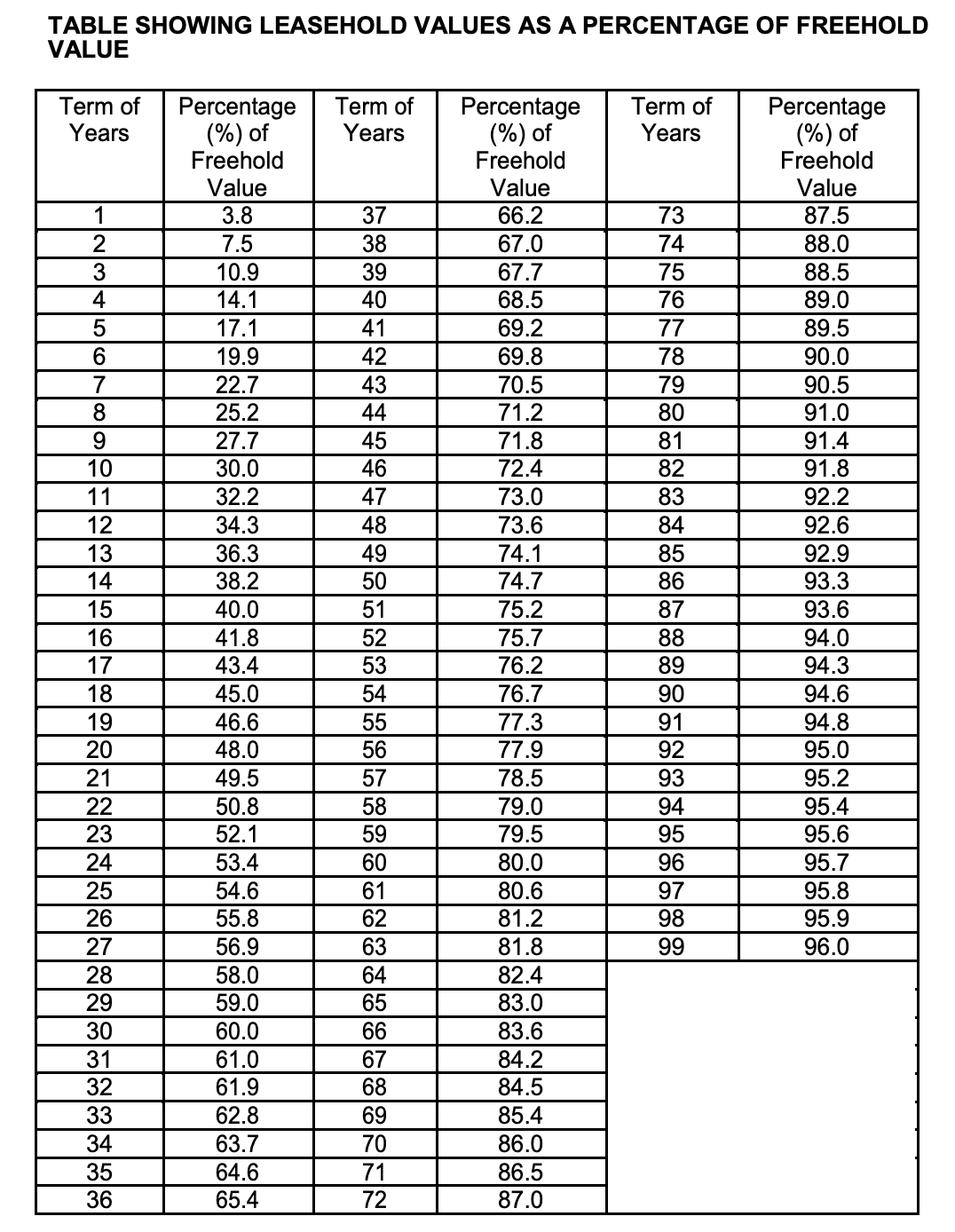
Note that Bala’s Curve does not follow a precise pattern and the fall in value over time is NOT linear (i.e. it falls faster as the property becomes older). Leasehold value does not decrease linearly in reality. Property values depreciate faster as the lease nears its end (e.g. the value of the last 30 years is lower than the value of the first 30 years).
The simplest explanation for the non-linear nature of Bala’s Curve is to treat the leasehold property is a future rental income source, while also considering inflation by introducing a discount rate to the formula.
In the rather complicated formula for Bala’s Curve, which we will not touch on here, rental income is assumed to rise at a constant rate, but still at about 3.5% below the discount rate (according to this report), which erodes the value of rental income.
With the formula, the value of the leasehold value decreases gently initially. But just after the 30-year mark, the discount rate makes its effect known (it is like the reverse of compound interest on your bank savings). As a result, your rental income in the later years of a lease (i.e. the value of that property) worth less and less at an ever faster rate until it hits zero at the end of the lease.
In reality, however, a leasehold property’s value will not start falling from day one. Real-world property prices, especially for newer homes, keep pace with inflation pretty well, hence avoiding the devaluing effects of the discount rate.
But eventually, at around the 40-year mark, mathematics catches up with the property no matter how many new amenities get built around it. You can see the effect on the older flats in Toa Payoh and Clementi.
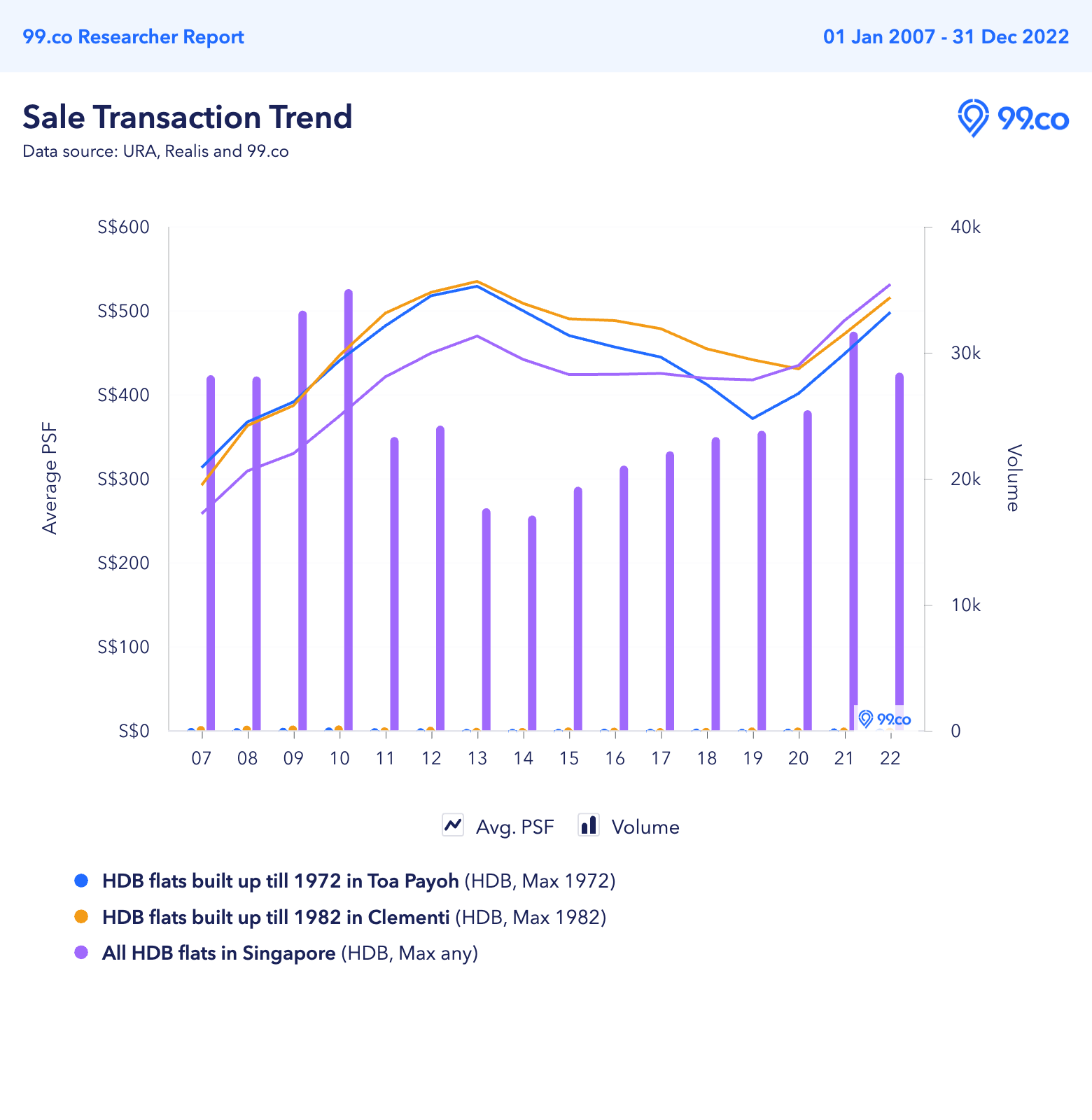
As we can see from the curve above, after the price peak in 2013, the value of the older Toa Payoh flats have slid at a faster rate than the value of the Clementi flats, which are 10 years younger.
From 2013 to 2019, prices of these flats were on a downtrend consistent with Bala’s Curve. This is precisely why banks and the HDB are reluctant to approve the full loan amount to buyers of properties with a shorter remaining lease, e.g. less than 60 years of a remaining lease for bank loans.
For HDB loans, HDB will not approve the full loan amount if the remaining lease of the property does not cover up till the age 95 of the buyer.
Using CPF funds are also regulated for these older properties.
(While we note that prices of these older flats have since increased over the last couple of years, this is because of the robust resale flat market, driven by pandemic factors such as construction delays and demand for bigger space.)
Properties over 40 years old for sale

 2
2
 2
2
 2
1
2
1
 3
2
3
2
 3
2
3
2
 3
1
3
1
 2
1
2
1
 3
1
3
1
 3
2
3
2
 3
2
3
2
 3
2
3
2
 3
2
3
2
 2
1
2
1
 2
2
2
2
 2
1
2
1
 2
2
2
2
 2
2
2
2
 2
1
2
1
 2
2
2
2
 3
1
3
1
 3
2
3
2
 2
2
2
2
 3
2
3
2
 2
1
2
1
 3
2
3
2
 1
1
1
1
 3
2
3
2
 3
1
3
1
 2
1
2
1
 3
2
3
2
 3
2
3
2
 3
2
3
2
 2
1
2
1
 3
2
3
2
 2
1
2
1
 3
2
3
2
 4
4
4
4
 3
2
3
2
 4
4
4
4
 4
3
4
3
 3
5
3
5
 1
1
1
1
 2
1
2
1
 3
2
3
2
 6
6
6
6
 4
5
4
5
 4
2
4
2
 2
2
2
2
 3
2
3
2
 3
2
3
2
 3
2
3
2
 3
3
3
3
 2
2
2
2
 1
1
1
1
 4
4
4
4
 4
5
4
5
 3
4
3
4
 1
1
1
1
 0
1
0
1
 2
2
2
2
 3
3
3
3
 5
5
5
5
 3
2
3
2
 4
4
4
4
 3
3
3
3
 4
4
4
4
 4
3
4
3
 4
5
4
5
 3
2
3
2
 4
4
4
4
 4
4
4
4
 6
5
6
5
 4
6
4
6
 5
4
5
4
 4
3
4
3
 4
4
4
4
 5
6
5
6
 5
6
5
6
 4
5
4
5
 5
6
5
6
 6
5
6
5
 6
6
6
6
 4
2
4
2
 5
4
5
4
 3
2
3
2
 3
2
3
2
 6
4
6
4
 6
5
6
5
 4
3
4
3
 4
3
4
3
 6
6
6
6
 7
7
7
7
 6
5
6
5
 6
8
6
8
 3
2
3
2
 6
5
6
5
 6
5
6
5
 7
6
7
6
 7
6
7
6
 6
3
6
3
 4
2
4
2
 5
7
5
7
 7
9
7
9
 5
5
5
5
 9
9
9
9
 6
4
6
4
Bala’s Curve used by HDB in its Lease Buyback Scheme?
Bala’s Curve probably also plays a role in HDB’s Lease Buyback Scheme (LBS). The LBS allow eligible older public flat owners to sell part of their lease (depending on your age, it will be a minimum of 15 years to a maximum of 35 years of the tail-end lease) to the HDB in exchange for cash/CPF proceeds. It is that HDB’s professional valuers use the SLA leasehold table to determine the value of the tail-end lease based on the current market value.
(Note that, however, HDB may be more generous towards flat owners who take part in the LBS, giving them higher proceeds than what mathematics would prescribe. This is done partly to compensate because flat owners can no longer rent out the whole flat, or choose to sell it on the open market, once they take up the LBS.)
Another consideration is the Voluntary Early Redevelopment Scheme (VERS), which we have yet to see in action. We know that during the VERS exercise, the government will compensate the flat owners based on the market value of their homes, which by then would have less than 30 years of remaining lease.
It seems probable that Bala’s Curve may be used as the guideline here, in working out the value based on the remaining lease—but this remains to be seen.
Some limitations exist for Bala’s Curve
Keep in mind that Bala’s Curve is not absolute. Don’t expect any entity—be it a government body or private developer—to adhere to it steadfastly.
One of the key factors here is the prospect of en-bloc sales and the developer’s qualitative judgement. Bala’s Curve does not consider a developer swooping in with an especially generous en-bloc offer, such as we often saw in 2017 and 2018. In the end, if a developer believes a location is under-valued, they may pay far more than Bala’s Curve implies they should.
On an individual level, we have seen things like a million-dollar sale for a 43-year-old flat in Tiong Bahru, which seems to have acquired the sellers so much profit that it seems like its leasehold status is lopsided in question. Well, that is because if there is an overwhelmingly positive attribute about the home, or if a certain type of property is scarce, old-fashioned demand-and-supply economics take over and Bala steps aside.
[Additional reporting by Virginia Tanggono]
Planning to sell your leasehold property soon? Let us help you get the right price by connecting you with a premier property agent.
If you found this article helpful, 99.co recommends Freehold vs 999/99-year leasehold condos — Which is the better choice? and What’s the appeal of 99-year leasehold landed properties?

About Ananda Bayu

Ananda has been wrangling Singapore's complex real estate trends into readable bites since 2020. She writes like she's explaining it to a friend over kopi — because who has time for jargon? When off the clock, she’s probably doom-scrolling through cat memes on X, convincing herself it's the highest tier of "creative inspiration".

Looking to sell your property?
Whether your HDB apartment is reaching the end of its Minimum Occupation Period (MOP) or your condo has crossed its Seller Stamp Duty (SSD) window, it is always good to know how much you can potentially gain if you were to list and sell your property. Not only that, you’ll also need to know whether your gains would allow you to right-size to the dream home in the neighbourhood you and your family have been eyeing.
One easy way is to send us a request for a credible and trusted property consultant to reach out to you.
Alternatively, you can jump onto 99.co’s Property Value Tool to get an estimate for free.
If you’re looking for your dream home, be it as a first-time or seasoned homebuyer or seller – say, to upgrade or right-size – you will find it on Singapore’s fastest-growing property portal 99.co.
Meanwhile, if you have an interesting property-related story to share with us, drop us a message here — and we’ll review it and get back to you.
Join our social media communities!
Facebook | Instagram | TikTok | Telegram | YouTube | Twitter





“This fact was made public in July 2020, so we know for a fact that the government uses this method to assess land values.”
Can I borrow your crystal ball?
Our bad, Ken! Thanks for pointing it out to us. We have since corrected the error.
Hehe, having a bit of fun commenting, but it’s a good read for me. Thanks for sharing this!
hi, can i ask how did you get the formula for the leasehold table ??
1y – 3.8%
2y – 7.5% etc ..
Thank u !