Build-to-Order (BTO) HDB flats are supposed to be generally cheaper than resale flats. But at some point, chances are that you or someone you know – likely a first-time homebuyer – have complained that BTO prices seem to be getting higher and higher. Even with the provision of housing grants for those earning below a certain income, many Singaporeans still feel that BTO flats should be priced lower than they currently are.
In this article, we’re looking to answer the question “Are BTO flats getting more expensive?” once and for all. To do this, we’ll be comparing BTO prices over time within various locations in Singapore. Within each location, we’ll also compare BTO prices with prices of resale flats, because according to the government, BTO flats are priced using a methodology that takes into account prices of comparable resale flats in the vicinity, as well as the specific attributes of the flats, such as storey height and design.
Because amenities, such as MRT stations, also factor towards the pricing of BTO flats, we’ll also be taking this into consideration in some of our case studies.
BTO prices case study #1: Woodlands
Let’s start with a non-mature estate that has consistently seen plenty of BTO sales exercises over the past 10 years: Woodlands.
| Woodlands | BTO Starting Prices (excluding grants) | |||||
|---|---|---|---|---|---|---|
| Launched | Project Name | 3-room | 4-room | 5-room | Distance to MRT | Average 4-room resale price in preceding quarter |
| May 2011 | Woodlands Peak | $167,000 | N.A. | N.A. | Near | N.A. |
| September 2012 | Treetrail @ Woodlands | N.A. | $248,000 | $308,000 | Within walking distance | $394,801 |
| May 2013 | Woodlands Pasture I and II | $133,000 | $223,000 | $276,000 | Quite far | $418,811 |
| November 2013 | Admiralty Grove | $156,000 | $238,000 | $307,000 | Within walking distance | $413,172 |
| January 2014 | Woodlands Glen | $145,000 | $234,000 | N.A. | Within walking distance | $402,080 |
| May 2014 | Admiralty Flora, Marsiling Greenview | $144,000 | $229,000 | $308,000 | Within walking distance | $393,257 |
| May 2017 | Marsiling Grove, Woodlands Spring | $145,000 | $236,000 | $312,000 | Within walking distance | $351,301 |
| February 2018 | Woodlands Glade | $140,000 | $225,000 | $279,000 | Quite far | $339,235 |
| May 2019 | Champions Green | $165,000 | $244,000 | $336,000 | Within walking distance | $332,216 |
| August 2020 | Champions Bliss, Urbanville @ Woodlands | $184,000 | $276,000 | $405,000 | Near | $346,667 |
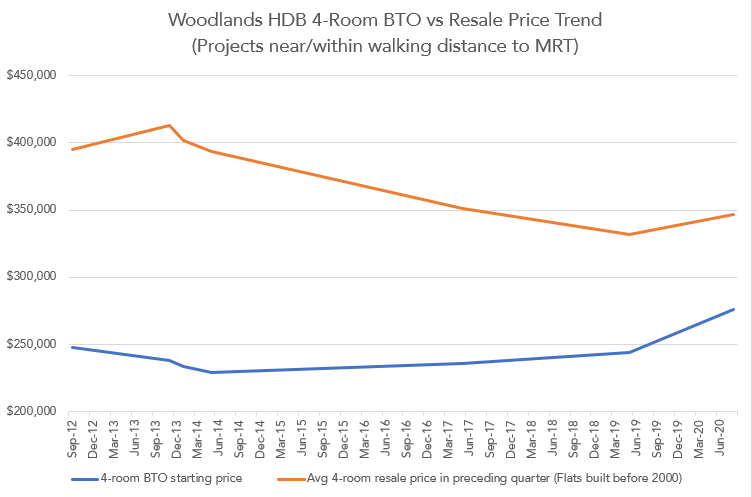
For Woodlands, let’s narrow the focus to two BTO projects built within walking distance or near an MRT station.
Comparing Admiralty Grove (Nov 2013) and Champions Green (May 2019), which are two BTO projects located within walking distance to an MRT station that’s one stop away from Woodlands, we can see that prices for 3-room, 4-room and 5-room BTO units increased by 5.8%, 2.5% and 9.4% respectively.
This is significant because, during this period, resale prices for comparable 4-room flats (same distance to MRT) fell by up to 25% during the same period, as the graph/map below shows:
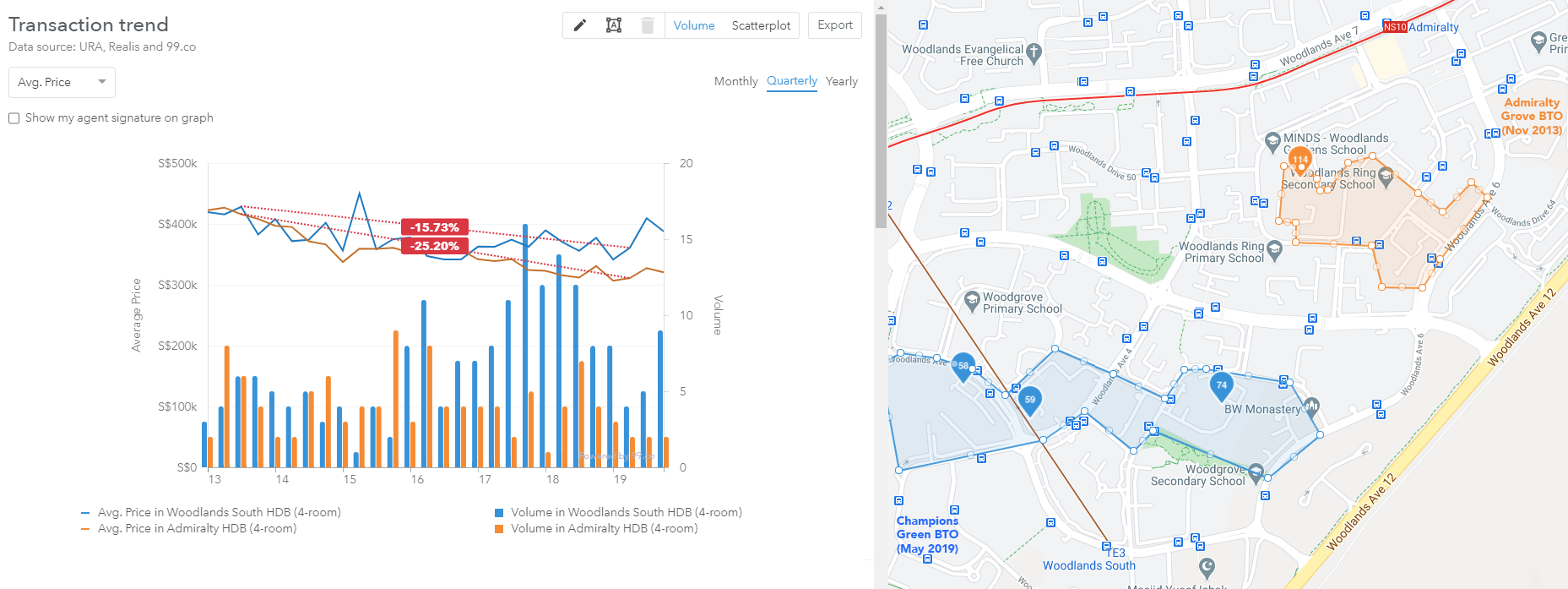
If one of the key factors to determine BTO prices was prices of resale flats in the vicinity, then why did BTO and resale prices move in opposite directions?
Going back to that first chart (the one without the map), what’s even more significant is that when Woodlands HDB resale prices finally bucked the downtrend recently, BTO prices increased by an even greater magnitude in the August 2020 BTO sales exercise.
In short, it’s reasonable to conclude that when HDB resale prices fall in Woodlands, BTO prices would increase. And if resale prices increase, BTO prices would increase even faster!
Granted, the projects launched in August 2020 are slightly nearer to the MRT station, but that alone cannot justify the crazy S$32,000 increase in 4-room flat starting prices (more than 13%) between May 2019 and August 2020 – a period of just 16 months!
BTO prices case study #2: Tampines North
Now, let’s take a look at Tampines North, a planned extention of Tampines New Town that will have its own MRT station on the Cross Island Line by 2029. The BTO flats that have been progressively launched here since May 2015 share largely similar attributes, because the area is so undeveloped.
| Tampines North | BTO Starting Prices (excluding grants) | ||||
|---|---|---|---|---|---|
| Launched | Project Name | 3-room | 4-room | 5-room | Average 4-room resale price in preceding quarter (Tampines New Town) |
| May 2015 | Tampines GreenWeave | $183,000 | $281,000 | $375,000 | $427,770 |
| August 2016 | Tampines GreenView, Tampines GreenVerge | $202,000 | $289,000 | $398,000 | $424,152 |
| November 2017 | Tampines GreenCourt | $216,000 | $323,000 | $438,000 | $435,561 |
| February 2018 | Tampines GreenDew, Tampines GreenFoliage | $205,000 | $296,000 | $417,000 | $432,283 |
| May 2018 | Tampines GreenVines | $210,000 | $312,000 | $422,000 | $430,743 |
| September 2019 | Tampines GreenGlen | N.A. | $312,000 | $418,000 | $427,343 |
| August 2020 | Tampines GreenCrest, Tampines GreenGlade | $205,000 | $311,000 | $423,000 | $412,189 |
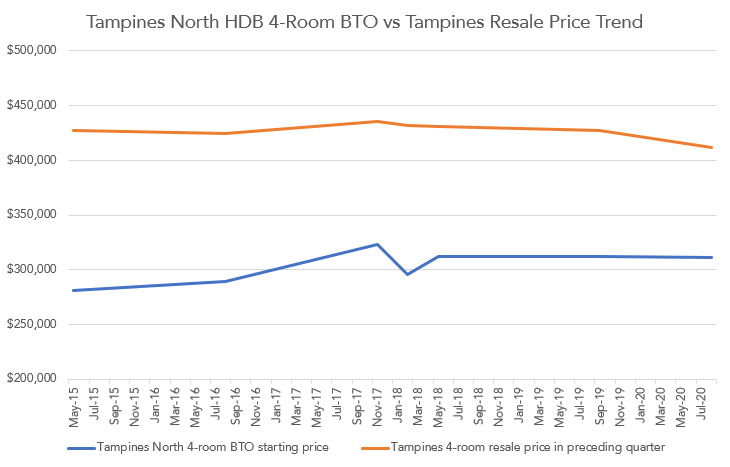
For BTO prices in Tampines North, we can see a discernable ‘bump up’ in BTO prices in November 2017 with the launch of Tampines GreenCourt, followed by an abrupt reduction in the subsequent sales exercise.
At the same time, there was a corresponding increase in 4-room resale prices in Tampines New Town, which could’ve prompted HDB to set their BTO prices higher in 2017, in line with their “methodology”.
Well, the November 2017 BTO sales exercise was a disaster. For a ‘mature estate’ project, Tampines GreenCourt was uncharacteristically undersubscribed by first-time buyers for 3-room and 4-room unit types. But this was no surprise, seeing as prices for project’s 4-room flats had risen nearly 12% in a span of 15 months, while prices of resale flats in Tampines had only increased by 2.7% in the same period from Aug 2016 to Nov 2017.
For those who argue that location and tenure has a part to play in the price increase, what we found was that average prices for resale HDB flats that are near MRT stations (Tampines West, Tampines, Tampines East) actually fell 3.0% between Aug 2016 to Nov 2017, whereas average prices for newer resale HDB flats (built 1995 or later) fell 4.82% in the same period.
So, we’re left with little clue as to how and why HDB suddenly listed a substantially higher price for the Tampines BTO flats in November 2017, before subsequently deciding to backtrack from that level.
BTO prices case study #3: Brickworks/Tengah
Before Tengah was announced as Singapore’s latest New Town in 2018 with plenty of bells and whistles such as parks everywhere and car-free transit corridors, HDB released thousands of BTO flats at the neighbouring Brickworks area in Bukit Batok from 2013 to 2017.
As Brickworks was also an undeveloped area back at the time, releasing a flurry of BTO flats there allowed HDB to calibrate the pricing for the eventual BTO projects at Tengah.
Based on the demand for Brickworks’ BTO flats, HDB could also better understand how to make Tengah, a brand new town, appear more attractive to Singaporeans.
It might sound cynical, but this is a pretty smart way to ensure that Tengah will be a success (as opposed to a ghost town). Anyway, here’s the price analysis:
| Brickworks/Tengah | BTO Starting Prices (excluding grants) | ||||
|---|---|---|---|---|---|
| Launched | Project Name | 3-room | 4-room | 5-room | Average 4-room resale price in preceding quarter |
| November 2013 | West Ridges @ Bukit Batok | $169,000 | $284,000 | $373,000 | $451,068 |
| May 2014 | West Crest @ Bukit Batok, West Valley @ Bukit Batok | $164,000 | $265,000 | $371,000 | $446,527 |
| September 2014 | West Terra @ Bukit Batok | $167,000 | $269,000 | $361,000 | $440,097 |
| February 2015 | West Edge @ Bukit Batok, West Rock @ Bukit Batok | $160,000 | $259,000 | $350,000 | $436,907 |
| November 2015 | West Quarry @ Bukit Batok | $161,000 | $272,000 | N.A. | $406,052 |
| February 2016 | West Plains @ Bukit Batok | $163,000 | $266,000 | $367,000 | $404,432 |
| August 2017 | Sky Vista, West Scape | $171,000 | $265,000 | $353,000 | $408,438 |
| November 2018 | Plantation Grove | $193,000 | $290,000 | $397,000 | $401,126 |
| May 2019 | Garden Vale @ Tengah, Plantation Acres | $192,000 | $309,000 | $415,000 | $367,699 |
| November 2019 | Plantation Village, Plantation Grange, Garden Vines @ Tengah | $208,000 | $302,000 | $409,000 | $376,530 |
| August 2020 | Parc Residences @ Tengah | $198,000 | $303,000 | $418,000 | $353,896 |
| November 2020 | Garden Court @ Tengah, Garden Terrace @ Tengah | $194,000 | $288,000 | $394,000 | $382,615 |
| February 2021 | Parc Woods @ Tengah | $209,000 | $298,000 | N.A. | $398,926 |
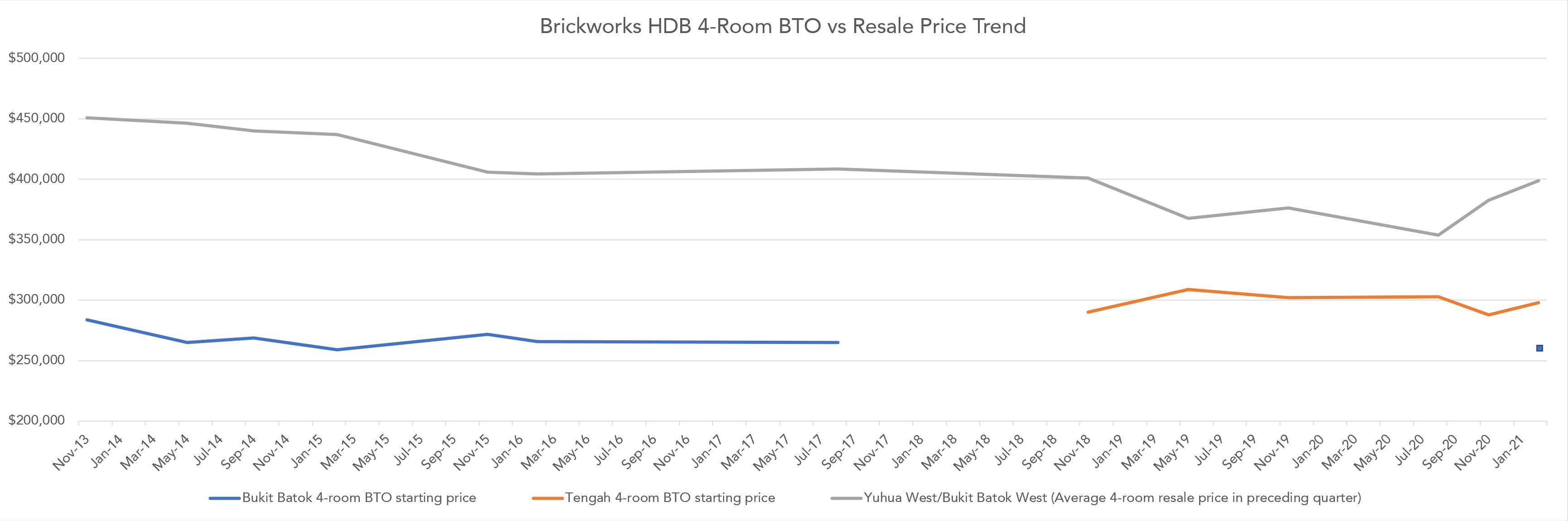
For resale prices, we used the two nearest neighbourhoods to Tengah (Yuhua West and Bukit Batok West) for accuracy. First thing we can see is that the decline in value for 4-room resale flats in these two neighbourhoods have been drastic throughout the period of our comparison – exceeding 20% – before a rebounding towards the end of 2020.
The constant fall in the value of resale flats in the vicinity should have, according to HDB’s BTO pricing methodology, resulted in cheaper BTO flats in Brickworks over time, but we can see that wasn’t the case.
With superior amenities such as the future Jurong Region MRT Line and centralised cooling technology in units, Tengah’s BTO starting prices are, quite understandably, set at about 10 to 15% above the BTO prices seen at Brickworks. Since the launch of the first Tengah BTO project, Plantation Grove, in 2018, prices in Tengah have also shown an increase of 3%, 4% and 5% for 3-room, 4-room and 5-room unit types respectively up until mid-2020.
However, in the recent Nov 2020 and Feb 2021 sales exercises, we’re seeing starting prices for Tengah’s 4-room BTO flats dip back below the S$300k mark. (We examine the possible reasons for this in our conclusion.)
It’s also noteworthy that the Feb 2021 BTO also saw the launch of the first Bukit Batok BTO project, West Hill @ Bukit Batok, since 2017. Surprisingly, prices for the project, which starts at S$260k for a 4-room flat, is cheaper than the West Plains @ Bukit Batok BTO project across the road, which was launched five years ago in Feb 2016 at starting prices of S$266k for 4-room flats. So, another price drop!
That being said, as Tengah takes shape, we expect its BTO prices to eventually continue its upward trajectory, and this is likely to be sooner rather than later if the older resale flats at Yuhua and Bukit Batok West continue their price rebound.
BTO prices case study #4: Bidadari
Bidadari, which is technically part of Toa Payoh New Town and considered a mature estate, arguably the second most publicised endeavour by HDB after Tengah, due to its proximity to the city.
Being sited on a recently exhumed cemetery hasn’t dimished Bidadari’s demand; all of its projects so far have been highly oversubscribed.
Here’s a snapshot of prices since the first Bidadari BTO project was launched in 2015, and per square foot (psf) resale flat prices in the nearby Potong Pasir neighbourhood:
| Bidadari | BTO Starting Prices (excluding grants) | ||||
|---|---|---|---|---|---|
| Launched | Project Name | 3-room | 4-room | 5-room | Potong Pasir resale HDB psf price |
| November 2015 | Alkaff Courtview, Alkaff Lakeview, Alkaff Vista | $297,000 | $433,000 | $544,000 | $476 |
| February 2016 | Alkaff Oasis | $303,000 | $440,000 | $546,000 | $464 |
| November 2016 | Woodleigh Glen, Woodleigh Village | $335,000 | $468,000 | N.A. | $466 |
| May 2017 | Woodleigh Hillside | $328,000 | $475,000 | $579,000 | $481 |
| November 2020 | Bartley Beacon, ParkView @ Bidadari | $324,000 | $466,000 | $627,000 | $446 |
| February 2021 | Bartley GreenRise | $312,000 | $496,000 | N.A. | $490 |
| February 2021 | ParkEdge @ Bidadari | N.A. | $476,000 | $612,000 | $490 |
| February 2021 | Alkaff Breeze | N.A. | $464,000 | $611,000 | $490 |
Without a doubt, we can see that while HDB has been steadily raising prices for BTO flats in Bidadari in the early days of the town, prices for 3- and 4-room flats have not risen as much as 5-room flats. (Note that the BTO projects at Bidadari is arguably within walking distance of a MRT station, be it Bartley, Woodleigh or Potong Pasir, so the ‘proximity to MRT’ factor in varying starting prices for Bidadari BTO flats should be minimal.)
In fact, we’d argue that 3-room BTO prices at Bidadari remained at roughly the same level from the first launch up till now. Comparing two projects that are located right to each other, Woodleigh Hillside (May 2017) and Bartley GreenRise (Feb 2021), we observe that starting prices for 3-room flat types fell, even as starting prices of 4-room flats increased.
While HDB has been holding back the prices of 3-room flats at Bidadari, the same can’t be said for the estate’s 5-room flats, which have increased by about 12% from November 2015 to date. While prices of Bidadari’s 4-room flats have also increased, it’s by only about 7 to 10%. Also, 4-room BTO flat prices at Bidadari appeared to have stopped increasing since November 2016, staying fairly constant.
Now if you break down the resale prices of different flat types in the neighbouring 35-year-old Potong Pasir HDB estate, you’ll see that it made sense to keep 3-room BTO flats at Bidadari fairly constant, simply because prices of these older resale flats nearby are steadily exhibiting a gradual downtrend.
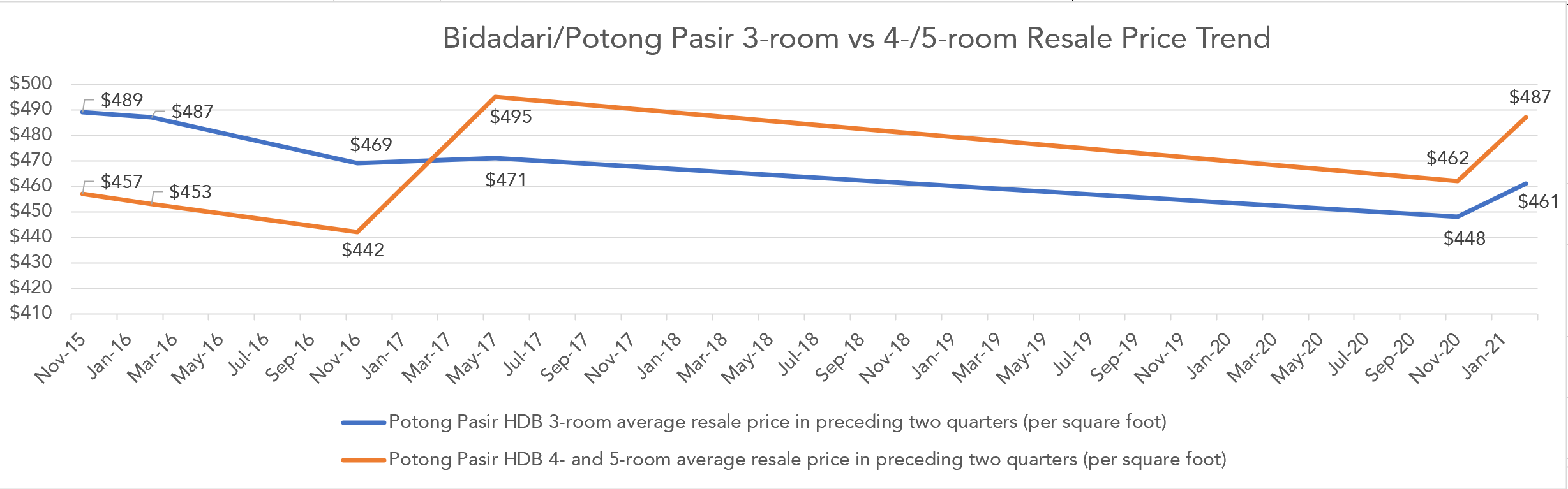
We also noticed that the bump up in Potong Pasir’s 4-room resale prices came after HDB had increased the prices for 4-room BTO units at Bidadari. So it could be a case of resale flat owners demanding a higher prices because of a spike in nearby BTO prices and succeeding, and not the other way around (i.e. BTO prices taking the cue of resale prices).
Observing the differences in price changes among different flat types, it’s logical why HDB would be more willing to increase the prices of 5-room BTO flats, compared to 3-room BTO flats. That’s because HDB needs to attain a base level of affordability, and 3-room flats are targeted at applicants with lower financial means.
On the other hand, applicants for 5-room flats are typically Singaporeans with a higher income, or multi-generational applicants with more than two income earners, so HDB might feel it’s more equitable to raise the prices of these larger flats compared to smaller 3-room flats.
BTO prices case study #5: Boon Keng
Just minutes away from Orchard Road and the CBD by train, Boon Keng (in Kallang/Whampoa New Town) is home to the priciest BTO flats launched in Singapore. In the May 2019 launch, Kempas Residences set the record for the priciest 3-room and 4-room flats ever launched:
| Boon Keng | BTO Starting Prices (excluding grants) | |||||
|---|---|---|---|---|---|---|
| Launched | Project Name | 3-room | 4-room | 5-room | Average 4-room resale HDB price for preceding two quarters (flats built before 2000) | Average 4-room resale HDB price for preceding two quarters (flats built 2000 or later) |
| November 2014 | St. Georges Towers | $328,000 | $459,000 | N.A. | $498,222 | $676,000 |
| February 2019 | Towner Crest | $374,000 | $523,000 | N.A. | $463,214 | $664,556 |
| May 2019 | Kempas Residences | $387,000 | $562,000 | N.A. | $435,429 | $709,632 |
| February 2021 | McNair Heights | $359,000 | $532,000 | N.A. | $486,227 | $712,389 |
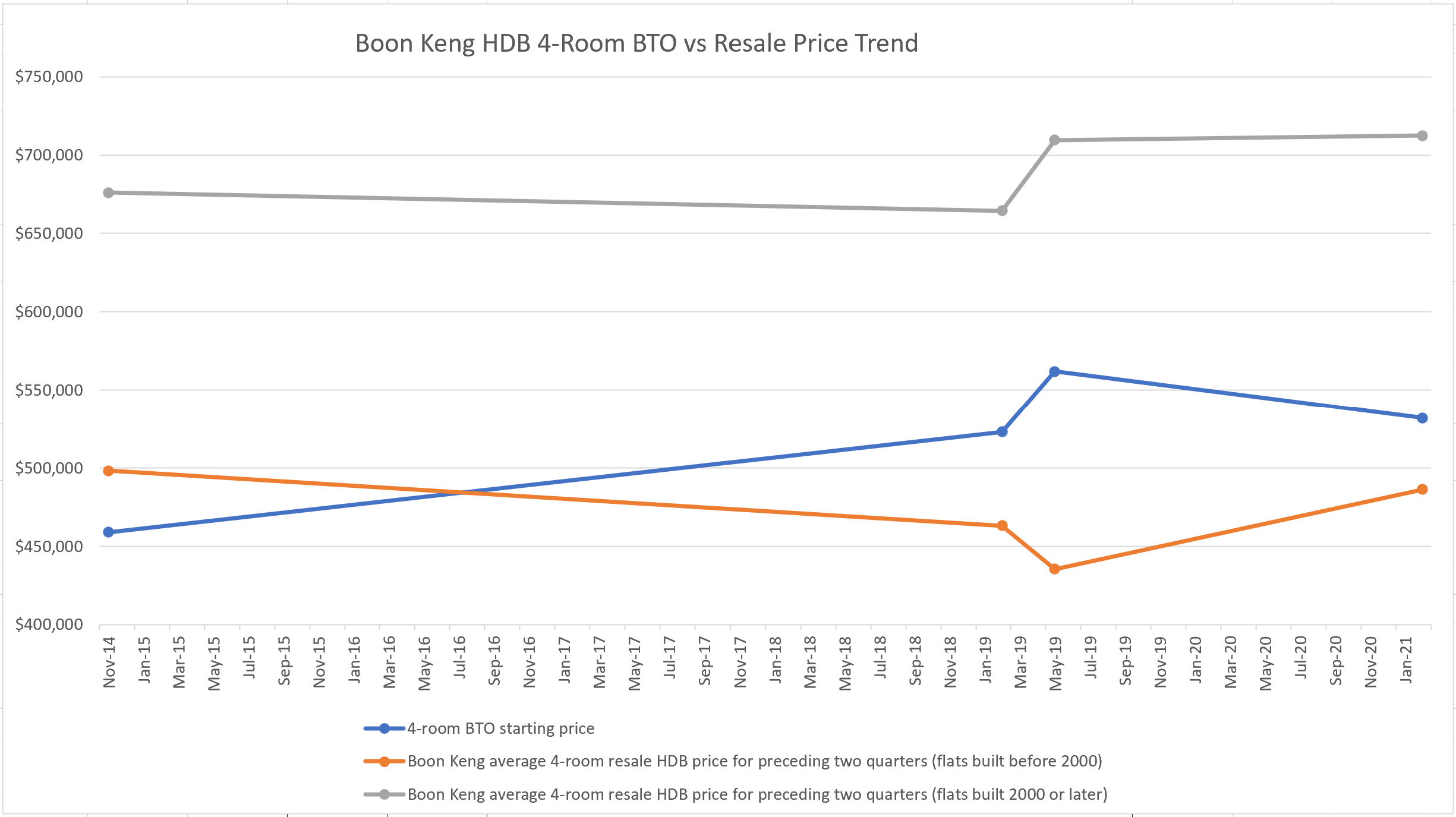
For our analysis of Boon Keng, we’ve spilt up older flats and newer flats, since housing here wasn’t built up at one go. There are a handful of 1970s flats, as well as blocks that are built after 2000. Due to differences in age, their resale value is quite far apart, as the chart above shows.
Even though BTO flats in Boon Keng are one of the most expensive that HDB has launched, its starting price still pales in comparison to those of newer resale flats. In fact, as resale prices climbed in 2021, prices for the McNair Heights project (launched in Feb 2021 BTO sales exercise) fell.
The rather significant price drop of S$20,000 to S$30,000 for McNair Heights, compared to the 2019 BTO projects, can be partly attributed to the fact that the project is located further away from Boon Keng MRT station. However, the MRT station is still within a walkable distance, so we think that the cheaper prices is a deliberate decision by HDB especially seeing resale flat prices continue to march higher.
BTO prices not a straightforward correlation with resale prices
You might also have noted that, from 2014 to 2019, when prices for newer resale flats at Boon Keng increased while prices for older resale flats fell, BTO prices somehow ‘chose’ to follow the price spike of the newer flats.
This seems unreasonable at first, but it’s important to realise that when HDB says they “take into account prices of comparable resale flats in the vicinity” when pricing a BTO flat, they don’t mean literally following the price trends of ageing resale flats.
Rather, what happens is likely this: HDB considers the age of nearby flats and applies calculations based on remaining tenure to find a hypothetical price as if the flats were brand new with a fresh 99-year lease, just like a BTO flat.
This explains why BTO prices will always lean towards the pricing of newer flats in the open market, while seemingly appearing to ignore the price trends of older resale flats in the vicinity.
But, even after taking into account tenure, we still observe BTO prices for some locations increase in a way that can’t be attributed to a single factor.
It’s especially hard to pinpoint a reason why starting prices for 4-room BTO flats near Boon Keng MRT increased 13.9% from November 2014 to February 2019, even as newer resale flats there had recorded a 1.7% price decrease.
And there’s evidence that HDB could be making BTO prices more affordable, in light of the Covid-19 pandemic.
When we updated this article in February 2021 with the latest BTO prices for Tengah, Bidadari and Boon Keng, we observed that the upward trend was reversed. Prices for BTO flats in these estates for the August and November sales exercises in 2020 and the February 2021 sales exercise were mostly either lower than the preceding years or kept at the same level, even though prices of HDB resale flats have been on an uptrend.
This could be an indication that HDB has made a deliberate decision to moderate the pricing of its BTO flats by taking the impact of the Covid-19 pandemic on Singaporeans into consideration. This is great news if it is indeed the case, as many Singaporean first-time homeseekers remain financially impacted by the economic effects of the pandemic.
Another reason for the halt in the BTO price uptrend could also be due to uncertainty over completion dates, given the manpower shortage due to Covid-19’s safe distancing measures and travel restrictions limiting foreign labour. While experts agree that concern over BTO completion dates have bolstered the HDB resale market with higher transaction figures and higher prices, there is also the possibility that HDB is responding to the popularity of resale flats by making BTO flats more attractive, price-wise, especially since BTO flats come with lower grant amounts.
Either way, BTO flats will still be oversubscribed, especially for mature estates such as Kallang/Whampoa. So, we can safely conclude that the recent moderation of BTO prices is a move borne out of an understanding of the average Singaporean’s financial situation, considering that we just experienced a 2.5% nominal decrease in our household income since the 2009 Global Financial Crisis.
The move to raise the prices of 5-room BTO flats at Bidadari, but not the prices of 3-room units, is also a sign that the government is sensitive to the needs of first-time homebuyers in the lower-income bracket, alleviating their financial burden by at least keeping BTO prices constant.
Or maybe there’s an element in HDB’s obscure BTO pricing formula that takes into account Singaporeans’ household income in coming up with BTO prices. Who knows?
Time for more transparency in BTO pricing?
A lot of guesswork and analysis goes into rationalising BTO prices, because there’s no detailed cost breakdown of new flats.
Actually, there was a time when HDB published cost breakdowns of new flats. The detailed breakdowns used to appear in old HDB Annual Reports.
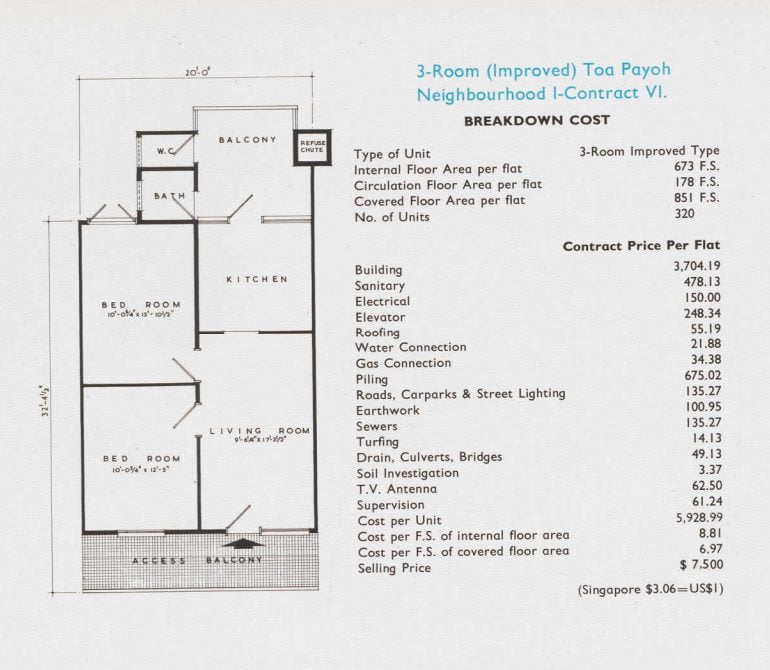
Sometime in the 1990s, the HDB stopped publishing these breakdowns, which was around the time that the Build-to-Order (BTO) scheme was launched.
Since then, noone has ever revealed, or ever managed to obtain, more information about how prices of individual BTO flats are determined, even though the matter is legitimately of public interest. (Our sympathies to the parliamentarians over the years who have attempted this fool’s errand.)
In any case, as long as HDB and the government keeps its cards close to themselves, Singaporeans (being Singaporeans) will be inclined to complain that BTO prices are forever rising, even when there is evidence of the contrary!
Are BTO prices getting too expensive? Share your thoughts in the comments below!
If you liked this article, check out Negative Sale: How selling your HDB/condo could put you in instant debt and How your HDB sale proceeds might get “taken” by CPF
About Kyle Leung

Content Marketing Manager @ 99.co

Looking to sell your property?
Whether your HDB apartment is reaching the end of its Minimum Occupation Period (MOP) or your condo has crossed its Seller Stamp Duty (SSD) window, it is always good to know how much you can potentially gain if you were to list and sell your property. Not only that, you’ll also need to know whether your gains would allow you to right-size to the dream home in the neighbourhood you and your family have been eyeing.
One easy way is to send us a request for a credible and trusted property consultant to reach out to you.
Alternatively, you can jump onto 99.co’s Property Value Tool to get an estimate for free.
If you’re looking for your dream home, be it as a first-time or seasoned homebuyer or seller – say, to upgrade or right-size – you will find it on Singapore’s fastest-growing property portal 99.co.
Meanwhile, if you have an interesting property-related story to share with us, drop us a message here — and we’ll review it and get back to you.
Join our social media communities!
Facebook | Instagram | TikTok | Telegram | YouTube | Twitter

In years to come many of our children can’t afford to buy BTO flats. The minimun salary wage for new worker is far compare to BTO price. And also the inflations of basic items tremendously will prevent them from getting married. Singapore populations will be shrinking unless instant import of migrant from other countries by the government. Subsequently the new citizens will realize that living in Singapore is very expensive and started to go for plan B which is migrating to other develop countries.
This is a great analysis! Thanks for putting this together and confirming my hunch. Would be interested to see your analysis for other estates and a biannual update for each estate. Somebody needs to send this to HDB and the government. I completely agree on the need for better transparency on BTO pricing. If these are public housing meant to be available at subsidised costs, why can’t land costs be absorbed by the government who anyways owns the land? This looks like monetisation of land at the expense of public housing buyers? Perhaps this is the government attempting to squeeze some funds from the good citizens of Singapore to compensate for the loss of revenue in other sectors due to the pandemic?